Why Are My Gears Skipping?
There are few things more annoying on a ride than gears that skip, clunk, or refuse to shift cleanly. The good news is that most of the time, the fix is simpler than you think and you may not need to visit a cycling mechanic at all.
By the end of this article, you will know the most common reasons gears skip, be able to try a few home fixes in under five minutes, and have a clear picture of when the problem genuinely needs a professional. No tools required for the first fix, and no prior mechanical knowledge assumed.
Note for Australian riders:
- Australian conditions, including red dust, coastal salt air, and intense summer heat, accelerate drivetrain wear faster than many international maintenance guides suggest.
- If you ride on gravel, fire trails, or near the coast, you likely need to clean and lube your chain more frequently than the standard advice recommends.
- Local bike shops (LBS) across Australia are generally happy to give an honest assessment. Most will tell you upfront if a fix is something you can do yourself.
At a glance:
- Cable tension is the most common cause of skipping gears and can be fixed in minutes using the barrel adjuster, no tools needed.
- A dirty or dry chain is another easy home fix. Clean and lube it before anything else.
- Worn chain, shark-finned cassette teeth, or a bent derailleur hanger all require a cycling mechanic.
- Basic gear adjustments at Australian bike shops typically cost between $20 and $60 AUD.
Key takeaways:
- Start with the simplest fix first: barrel adjuster tweak, then chain clean and lube, then see a mechanic.
- Skipping under load while climbing is a strong sign of worn components, not a cable issue.
- Ignoring a bent hanger or worn cassette leads to bigger repair bills down the track.
The Most Common Causes at a Glance
Skipping gears usually comes down to one of a handful of causes. Before reaching for your wallet, it helps to understand what is most likely going on.
| Cause | What you notice | Home fix possible? |
|---|---|---|
| Cable tension out | Skipping across multiple gears, slow to shift | Yes - barrel adjuster |
| Dry or dirty chain | Grinding, rough feel, occasional skip | Yes - clean and lube |
| Worn chain | Skipping under load, especially climbing | No - needs replacement |
| Worn cassette | Skipping consistently on certain gears | No - see a mechanic |
| Bent derailleur hanger | Inconsistent shifting across all gears | No - needs straightening |
| Damaged cable or housing | Stiff shifting, not returning cleanly | Sometimes - mechanic advised |
The 5-Minute Home Fixes You Can Try Right Now
Think of these as the first things a mechanic mate would check before even picking up a tool. Start at the top and work your way down. Most skipping problems are solved at step one.
Barrel Adjuster Tweak - The First Thing to Try
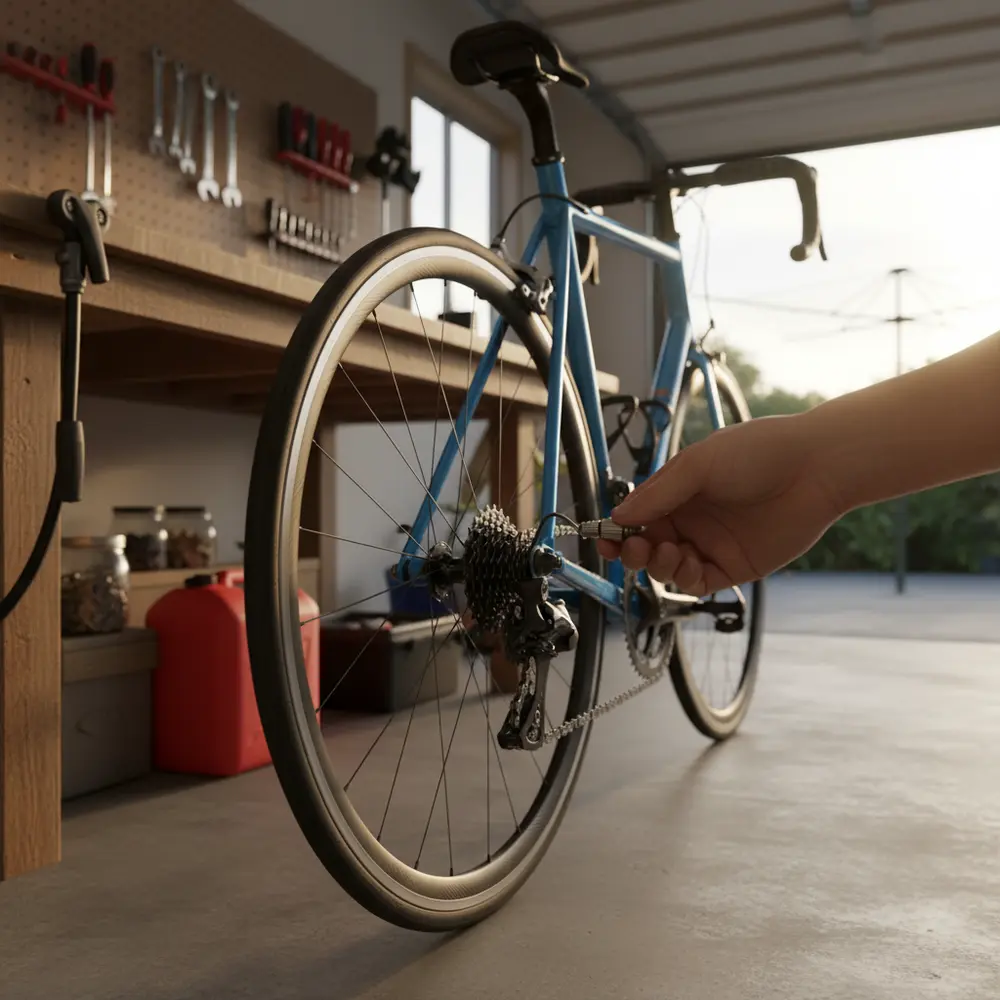
The barrel adjuster is a small knurled dial where the cable housing meets your rear derailleur or the shifter on your handlebars. Turning it counter-clockwise adds cable tension, which nudges the derailleur toward the larger sprockets. Turning it clockwise reduces tension. According to the barrel adjuster adjustment guide on bicycles.net.au, this is the recommended first step for most skipping issues.
Here is how to do it in the car park or your garage:
- Shift to the middle of your cassette (a middle gear, not the extremes).
- Spin the pedals and listen for the skip.
- Turn the barrel adjuster counter-clockwise by a quarter turn at a time.
- Spin the pedals again and check. Repeat until the skip goes away.
- If you over-correct and the chain starts climbing toward a bigger sprocket, turn it back clockwise a quarter turn.
That is genuinely it. No tools. No stand required. You can do this roadside mid-ride if the skipping starts on the way out.
Checking Cable Tension
Over time, cables stretch. This is completely normal and it is the single most common reason gears go out of adjustment, especially on a newer bike in the first few months of riding. The barrel adjuster fix above is essentially a cable tension correction. If the barrel adjuster runs out of thread before the skipping stops, the cable may need to be re-tensioned at the anchor bolt, which is a job for your local bike shop. As the team at Sheldon Brown's derailleur adjustment reference notes, cable tension is the single most important factor in accurate indexed shifting.
Also check the cable housing for any kinks, cracks, or fraying. Damaged housing causes stiff or inconsistent shifting that no amount of barrel adjuster tweaking will fix permanently.
Cleaning a Dirty or Dry Chain
A chain that is caked in grit or bone dry will skip and grind, even when everything else is correctly adjusted. This is especially true for Australian riders dealing with red dust on gravel roads or salt air near the coast. A quick clean and re-lube can resolve skipping entirely in these cases. The chain lubing guide on bicycles.net.au walks through the process clearly for beginners.
- Wipe the chain down with a clean rag while backpedalling to remove old lube and grit.
- Apply fresh lube to each link, one drop at a time, while slowly turning the pedals backward.
- Wipe off any excess lube. More is not better. Excess lube attracts dirt and speeds up wear.
- Use dry lube in Australian summer or on dusty trails. Use wet lube for winter or wet conditions.
If the chain looks black with built-up grime, give it a proper degrease before re-lubing. A chain cleaner tool and a bottle of degreaser costs very little and is worth keeping in the garage.
Warning Signs That Tell You to See a Cycling Mechanic
Some problems look like a cable tension issue on the surface but are actually worn or damaged components underneath. Trying to adjust your way out of these will not work and riding on them longer causes more damage. Here is what to look for.
Worn Cassette or Chainrings
Cassette teeth wear into a distinctive shark-fin shape over time. When this happens, the chain can no longer seat properly and will skip, especially under load. If you notice skipping that gets worse when you are climbing or sprinting, worn components are the likely cause rather than cable tension. Replacing only the chain when the cassette is already worn usually leads to continued skipping because the new chain does not fit the worn tooth profile properly.
According to the chain wear indicator guide from Park Tool, a chain checker reading of 0.5 means the chain should be replaced to protect the cassette. At a reading of 0.75, the cassette is likely already damaged and will need replacing too. A cycling mechanic can check this for you quickly and give you an honest assessment.
Bent Derailleur Hanger
The derailleur hanger is a small piece of aluminium that holds the rear derailleur to the frame. It is designed to bend or break in a crash to protect the frame and derailleur. A bent hanger causes the derailleur to sit at the wrong angle, which results in inconsistent shifting across all gears. No amount of cable adjustment will fix a bent hanger. As BikeRadar's gear slipping troubleshooting guide explains, a bent derailleur hanger requires straightening or replacement, and it is not a beginner job.
Signs of a bent hanger include shifting that feels fine in some gears but terrible in others, or the derailleur visually sitting at an angle when viewed from behind the bike. If you had a recent crash or knocked the bike over, check this first.
Chain Wear Beyond the Limit
Chains stretch as they wear. A stretched chain does not sit correctly on the cassette or chainrings and will skip under any real load. Checking chain wear requires a cheap chain checker tool, available at any bike shop or online for a few dollars. If you do not have one, your local bike shop can check it in under a minute.
The key thing to know here: riding on a worn chain damages the cassette. A cassette costs significantly more than a chain, so replacing the chain on schedule is the cheaper long-term move. Australian conditions, particularly red dust and grit, accelerate this wear faster than what many international guides assume for typical conditions.
Quick Decision Guide - Home Fix or Mechanic?
Use this decision flow to work out what to do next. Start at the top and follow the path that matches your situation.
- Is the skipping new and across multiple gears? Try the barrel adjuster first. If that does not fix it after a few quarter-turn adjustments, move to step 2.
- Is the chain dirty or dry? Clean and lube the chain. If skipping continues after that, move to step 3.
- Did the skipping start after a crash or knock? Inspect the derailleur hanger. If it looks bent or the derailleur sits at an angle, take it to a cycling mechanic.
- Is the skipping worse under load, like climbing? This points to chain or cassette wear. Get the chain checked with a chain checker tool. If it is at or beyond 0.5 on the gauge, see a mechanic.
- Is the skipping on one specific gear only? That particular sprocket tooth may be damaged. See a cycling mechanic for assessment.
- Have you tried all of the above and it is still skipping? Book a gear service at your local bike shop. Some issues, like cable housing damage or limit screw settings, need a trained eye.
If you are unsure at any point, the team at your local cycling community or a trusted bike shop will point you in the right direction without any pressure.
How Much Does a Gear Service Cost in Australia?
Cost is a fair concern and it helps to know what you are likely up for before walking in the door. The good news is that a basic gear adjustment is one of the more affordable bike shop services.
| Service type | Typical cost (AUD) | What is included |
|---|---|---|
| Basic gear adjustment | $20 - $60 | Cable tension, indexing, barrel adjuster set up |
| Derailleur hanger replacement | $20 - $50 (parts + labour) | New hanger fitted and derailleur re-aligned |
| Chain replacement | $20 - $80 (parts + labour) | New chain fitted and indexed |
| Chain and cassette replacement | $80 - $200+ (parts + labour) | New chain and cassette, re-indexed |
| Full drivetrain service | $150 - $300+ | Clean, inspect, and adjust full drivetrain |
Prices vary between shops and regions, but the figures above are a reasonable guide for most Australian bike shops as of 2024-2025. You can find more detail on what different service levels include in the bike servicing guide on 99bikes.com.au. Most reputable shops will give you a quote before starting work.
Common Mistakes to Avoid
- Over-adjusting the barrel adjuster. One big turn will throw the indexing way off. Stick to quarter-turn increments and check after each one.
- Lubing a dirty chain without cleaning it first. Adding lube on top of grit just creates a grinding paste. Always wipe the chain down before lubing.
- Replacing only the chain when the cassette is worn. The new chain will skip on worn teeth immediately. Always check cassette condition at the same time.
- Riding on a bent hanger and hoping it sorts itself out. It will not. The longer you leave it, the more inconsistent your shifting will become and the higher the risk of damaging the derailleur itself.
- Using the wrong lube for your conditions. Wet lube in dusty Australian summer conditions will attract grit and accelerate wear. Match your lube to your conditions.
- Ignoring skipping under load. If the skip only happens when you are pushing hard on the pedals, that is a component wear warning, not a cable issue. Get it checked.
If You Are New to Bike Maintenance
Start here if you have never adjusted a gear in your life. These are the things most worth knowing before you try anything.
- The barrel adjuster fix requires zero tools and zero experience. It is the safest place to start.
- You cannot easily break anything by turning the barrel adjuster a few clicks. If things get worse, just turn it back.
- A chain checker tool costs around $10 to $20 at most Australian bike shops and is worth owning.
- Your local bike shop is not going to judge you for bringing in a simple problem. They see it every day and most are happy to show you what they are doing.
- Cleaning and lubing your chain every few rides is the single best habit you can build for drivetrain longevity. You can learn more about basic bike maintenance on Segment Club.
If You Have Done Basic Adjustments Before
If you have already gone through the barrel adjuster and chain clean steps and are still having trouble, here is where to look next.
- Check the cable housing end caps. A missing or cracked cap at the derailleur end causes erratic tension and is a two-minute fix with a pair of pliers and a spare cap.
- Inspect the derailleur hanger by sighting from behind the bike. The derailleur cage should be perfectly parallel to the cassette. Any visible angle means a bent hanger.
- Check the limit screws. These are the two small screws (usually marked H and L) on the rear derailleur. They control the physical range of travel and should not need adjusting unless the chain is dropping off the top or bottom of the cassette.
- If you are on a 1x drivetrain, the barrel adjuster method works the same way as on a 2x or 3x setup. The indexing principle is identical.
- If the issue persists after a thorough check, a gear service from a qualified cycling mechanic is the right call. Some things, like cable housing replacement or hanger alignment with a proper alignment tool, are genuinely better done by someone with the right gear.
Frequently asked questions
Can I keep riding with skipping gears?
For a short ride home, it is usually fine. But riding on skipping gears for extended periods accelerates wear on the chain, cassette, and chainrings. If the skipping is caused by a worn component, continuing to ride on it risks damaging other parts of the drivetrain and turning a cheap fix into an expensive one.
Why do my gears skip only when I am climbing?
Skipping under load, such as when climbing a hill or sprinting, is a strong indicator of chain or cassette wear rather than a cable tension problem. Cable tension issues tend to produce skipping across normal riding. If it only happens when you are pushing hard, get the chain wear checked with a chain checker tool as a first step. You can read more about chain skip under load on Bicycling Australia.
Do I need to replace the cassette and chain at the same time?
Not always, but often yes. If the chain wear reading is at or beyond 0.75, the cassette teeth are likely already worn to the point where a new chain will not sit correctly on them and will continue to skip. Your mechanic will check the cassette condition when replacing the chain and advise you honestly. Replacing both together when needed is cheaper than doing them separately a few weeks apart.
How do I know if my derailleur hanger is bent?
Stand directly behind the bike and look at the rear derailleur. The two pulleys (the small wheels in the derailleur cage) should line up directly below each other and be parallel to the cassette. If the cage looks angled or twisted, the hanger is likely bent. Inconsistent shifting across all gears, rather than just one or two, is another strong indicator. A cycling mechanic can confirm this quickly with a hanger alignment tool.
Is a gear service at an Australian bike shop worth it?
Yes, for most riders, absolutely. A basic gear service typically costs between $20 and $60 AUD and will have your shifting dialled in properly. It also gives the mechanic a chance to flag any other wear issues before they become costly. Think of it as a health check rather than just a fix. Most Australian bike shops are straightforward about what is and is not necessary. Check out our guide to when to take your bike to a mechanic for more on this.
A Quick Summary
- Start with the barrel adjuster. It is free, takes five minutes, requires no tools, and fixes the majority of skipping gear problems.
- Clean and lube the chain before making any other adjustments. A dirty chain causes skipping and masks other issues.
- Skipping under load means worn components. Get the chain checked and see a cycling mechanic if the wear is at limit.
- A bent derailleur hanger and a worn cassette are not home fixes for beginners. Take them to a qualified cycling mechanic before the damage gets worse.
- Basic gear services in Australia are affordable and worth it. Most shops are honest and will not upsell you on work that is not needed.
If you are still not sure what is going on with your bike, feel free to get in touch with the Segment Club team and we will point you in the right direction.
This is educational content, not professional mechanical advice. Always consult a qualified cycling mechanic if you are unsure about the condition of your bike or its components.