A botched cable job is one of the most common things a bike mechanic sees coming through the workshop, and almost every time the culprit is the same: the wrong cutter or no cutter at all. Getting your cables and housing right makes a real difference to how your brakes feel and how cleanly your gears shift.
By the end of this article you will know exactly which tools to buy, how to use them step by step, and how to avoid the mistakes that turn a simple job into a frustrating afternoon. Whether you are replacing cables for the first time or looking to tighten up your technique, this is the practical reference you need.
Note for Australia:
- Tools like the Park Tool CN-10, Shimano TL-CT12, and Pedro's cable cutters are all available through Australian retailers including Pushys Australia and most local bike shops.
- Australian pricing on quality cable tools can sit higher than US prices due to import costs, but mid-range options from Shimano and Pedro's offer solid value for home mechanics.
- Jagwire cable and housing kits, including ferrules and end caps, are widely stocked at Australian bike shops and online retailers.
At a glance:
- A dedicated bike cable cutter is not optional - it is the single most important tool for a clean cable job.
- Brake housing and derailleur housing are different products with different constructions and they are not interchangeable.
- Ferrules, end caps, and a housing reamer are the supporting tools that separate a professional result from a rough one.
- Mid-range cutters like the Shimano TL-CT12 are more than adequate for a home mechanic doing their own bikes.
Key takeaways:
- Use a purpose-built cable cutter every time - hardware store snips crush housing and cause friction and poor feel.
- Always ream, deburr, and cap your cuts before threading inner wire.
- Match your housing type to the application: coil for brakes, compressionless for derailleurs.
Why the Right Cable and Housing Tools Actually Matter
Cable and housing work sits right at the heart of how your bike responds. Your brakes and gears rely on the inner wire moving freely inside the housing with as little friction as possible. Any compromise at the cut end, whether that is a crushed liner, a jagged edge, or a frayed wire, adds friction and inconsistency that no amount of barrel adjuster tweaking will fix.
The good news is that a proper cable job is straightforward once you have the right tools in hand. It is one of those maintenance tasks where the difference between doing it properly and doing it badly comes down almost entirely to your toolkit, not your skill level.
What Happens When You Use the Wrong Cutter
Standard wire cutters, side snips, and hardware store pliers use a crushing or pinching action rather than a clean shear. On cable housing, that means the outer jacket collapses inward and crushes the liner. The result is a restricted bore that the inner wire has to fight through every time you pull the lever. As BikeRadar explains in their cable cutting guide, purpose-built cutters use a shearing action that slices cleanly through the housing without deforming the structure.
On derailleur cable, a crushed housing end causes inconsistent cable tension, which directly affects indexed shifting. On brake cable, it adds resistance to lever pull and reduces modulation. Neither outcome is something you want to chase down after a full rebuild.
Types of Bike Cables and Housing You Will Be Working With
Before you reach for a cutter, it helps to understand what you are cutting. Not all housing is the same, and using the wrong type in the wrong place is a problem no amount of good cutting technique will solve. For a solid technical overview, the bicycle cable housing types explained on Sheldon Brown remains one of the most detailed references available.
Brake Housing vs Derailleur Housing - Key Differences
Brake housing uses a coil-wound steel wire wound in a spiral around a plastic liner. This construction handles the compressive forces of brake cable pulls well. Derailleur housing, by contrast, uses parallel strands running lengthwise, which resists compression along the housing axis and is critical for accurate indexed shifting. These two housing types look similar on the outside but are built differently and are not interchangeable.
| Housing Type | Construction | Used For | Key Property |
|---|---|---|---|
| Brake housing (coil) | Spiral-wound wire | Brake runs | Handles pull-force compression |
| Derailleur housing (compressionless) | Parallel strands | Gear runs | Resists axial compression for accurate indexing |
| Full-length liner (internal routing) | Plastic tube inside frame | Internal routed bikes | Protects inner wire through the frame |
Compressionless Housing and When It Applies
Compressionless housing is the standard for derailleur cable runs and is what most indexed shifting systems require to work correctly. Testing by Bicycle Rolling Resistance on cable housing performance shows that compressionless housing reduces lever travel variation under braking loads compared to standard coil housing. For brakes, the difference is most noticeable on longer cable runs or when you are pushing hard on the levers.
Standard coil housing is still perfectly adequate for brake runs on most bikes. You do not need to upgrade to compressionless brake housing unless you are chasing marginal gains or running a particularly long brake cable run. For derailleur cables, though, always use compressionless housing.
Cable Cutters - What to Look For and What to Avoid
The job of a good cable cutter is simple: produce a square, clean cut through the housing without deforming the liner or collapsing the outer jacket. The mechanism that achieves this is a shearing blade rather than a pinching jaw. When you are shopping for a cable cutter, that shearing action is the one feature that separates a tool that works from one that does not.
A few things to check when buying:
- Shearing blade design, not a pinching or crushing jaw
- Hardened blades that will hold an edge over time
- A cutter that handles both inner wire and outer housing cleanly
- Comfortable grip if you are doing multiple bikes
- Replacement blade availability for long-term use
Budget Options vs Professional-Grade Cutters
For a home mechanic doing their own bikes, you do not need a professional-grade cutter. The Shimano TL-CT12 sits in a mid-range price bracket and is Shimano's own recommended tool for cable and housing work. It handles both brake and derailleur housing cleanly and is widely available through Australian retailers. The Park Tool CN-10 and CN-10C2 step up in quality and longevity, but at a higher price point that makes more sense if you are regularly working on multiple bikes.
Avoid anything sold as a general-purpose wire cutter from a hardware store. The blades are not designed for the task and the result will show every time you pull the lever. A mid-range dedicated cutter from a bike brand is the right starting point, full stop.
Supporting Tools You Need Alongside Your Cable Cutters
A good cutter gets you a clean cut. But a clean cut is only the start. The steps that follow, reaming the liner, fitting ferrules, and capping the inner wire, are what make the difference between a cable job that feels slick from day one and one that feels rough and needs constant adjustment.
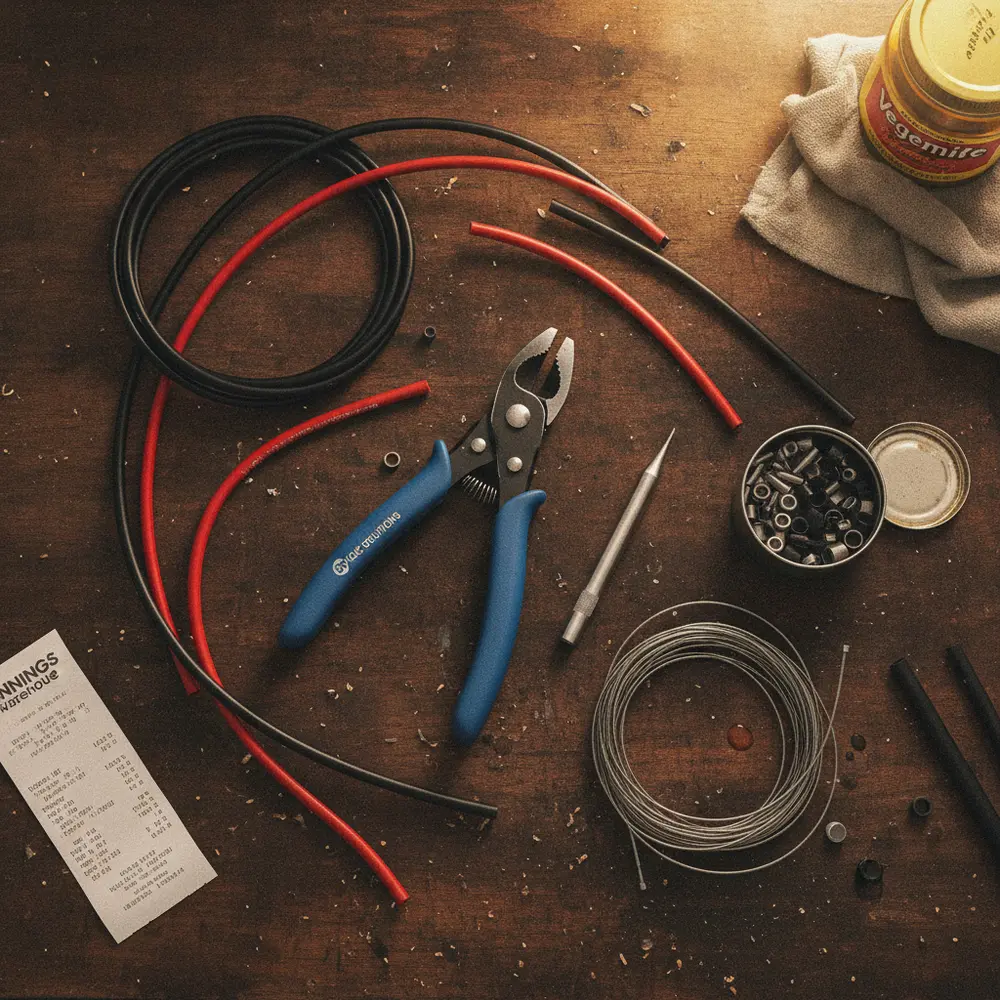
Files, Ferrules, End Caps and Housing Reamers
Here is what you need beyond the cutter itself:
- Housing reamer or awl: After cutting, the liner at the housing end gets partially closed. A reamer re-opens the bore so the inner wire runs freely. Skipping this step adds unnecessary friction at every cut end.
- Small file or deburring tool: Used to smooth any rough edge on the housing end that might catch the inner wire or prevent the ferrule from seating flat.
- Ferrules: These small caps fit over the end of the housing and seat inside the cable stop or component port. They protect the housing end and ensure clean, consistent seating. Some modern frame and component ports are designed for ferrule-free entry, so check your frame and component spec before assuming ferrules are always needed.
- End caps (cable tips): Always crimp an end cap onto the inner wire after cutting it to length. End caps prevent the wire from fraying under the anchor bolt and are essential for a tidy, long-lasting result.
- Needle-nose pliers or crimping tool: Used to crimp end caps. Firm pressure is enough - over-crimping can cause the cap to split or separate.
Ferrules, end caps, and cable kits from brands like Jagwire and Shimano are readily stocked at Australian bike shops and through online retailers. Buying a complete kit ensures everything is compatible from the start, which saves a trip back to the shop mid-job. See the Jagwire cable and housing installation guide for ferrule selection notes matched to common component ports.
Step-by-Step - How to Cut and Prep Cable Housing Like a Pro
This process applies to both brake and derailleur housing. Work through each step in order and do not skip the finishing steps at the end.
- Measure before you cut. Hold the housing against the cable run with the bars turned to full lock in both directions. Housing that is too short will bind and cause poor brake or shift feel. Housing that is too long creates excess friction. Mark the cut point with a marker or tape.
- Make the cut square. Position the cutter blade perpendicular to the housing axis. An angled cut will cause the housing to seat unevenly in the cable stop or ferrule, leading to inconsistent feel. Apply firm, single-motion pressure through the cutter - do not rock or twist the tool.
- Ream the liner. Use a housing reamer or a pointed awl to re-open the liner bore at the cut end. Insert gently and rotate slightly to open the plastic liner without damaging the inner wall. This step directly reduces friction at each housing junction.
- Deburr the cut end. Run a small file or deburring tool lightly across the cut face to remove any wire burrs or rough edges. The end should sit flat and even.
- Fit the ferrule. Slide the correct ferrule onto the housing end and press it firmly into place. Check your frame and component spec - some modern internally routed bikes and certain component ports are designed to accept housing without ferrules.
- Thread the inner wire. Feed the inner wire through the housing before cutting it to final length. This ensures the wire is correctly routed through all guides and barrel adjusters before you commit to the cut.
- Cut the inner wire and cap it. Once the inner wire is correctly routed and tensioned, cut it to length, leaving enough tail for re-adjustment. Immediately crimp an end cap onto the cut end to prevent fraying.
- Check and adjust. Cable stretch is normal on new installations. Plan to re-tension via the barrel adjusters after your first few rides.
For a full reference on the replacement process, the Park Tool cable and housing replacement guide covers the process in detail with tool references at each step.
Recommended Cable and Housing Tools Available in Australia
All of the tools below are available through Australian retailers. Prices vary and Australian pricing is generally a little higher than US pricing due to import costs, but all of these represent good value for a home mechanic.
| Tool | Who It Suits | Notes |
|---|---|---|
| Shimano TL-CT12 | Home mechanic | Mid-range, handles brake and derailleur housing, widely stocked in Australia |
| Park Tool CN-10 / CN-10C2 | Home mechanic to workshop | Professional-grade, longer lifespan, higher price point |
| Pedro's Cable Cutter | Home mechanic | Mid-range alternative, available through Pushys and local shops |
| Housing reamer | All home mechanics | Small tool, big difference to cable friction - do not skip it |
| Jagwire or Shimano cable kit | All home mechanics | Includes housing, ferrules, end caps - ensures compatibility |
Your local bike shop is always worth a call before ordering online - many carry these tools on the shelf and you can get them the same day. Get in touch with us if you have questions about what tool suits your setup.
A Note on Internal Cable Routing
If you are riding a newer gravel or road bike with full internal cable routing, the job gets a bit more involved. Internal routing often requires a magnetic cable routing kit or a plastic liner to guide the inner wire through the frame. The housing prep process is the same, but routing the inner wire through the frame requires patience and sometimes a second set of hands.
Full-length liner systems, where a continuous plastic tube runs through the frame from lever to component, are increasingly common on modern bikes. With these systems, you do not cut the housing at intermediate stops in the traditional sense. The liner stays in the frame and only the inner wire is replaced. Check your bike's manual or manufacturer spec before starting a cable job on a fully internally routed frame.
Common Mistakes and How to Spot a Bad Cut
If you are new to this or have had cable jobs go sideways before, watch for these:
- Using general wire cutters or snips from the hardware store - they crush the housing liner every time
- Skipping the reaming step and wondering why the cable feels stiff at the housing junctions
- Cutting housing at an angle instead of square, causing uneven seating in the cable stop
- Forgetting end caps on the inner wire, leading to fraying at the anchor bolt
- Measuring housing too short - it will bind under steering load and affect brake feel immediately
- Over-crimping end caps and splitting them off the wire during installation
A bad cut usually shows up straight away. If brake lever feel is inconsistent or shifting is sluggish right after a fresh cable job, go back and check each housing end. Look for a crushed or collapsed bore, a ferrule that is not seating flat, or a liner that has not been reamed open.
If You Are New to Cable Work
- Buy a dedicated bike cable cutter before you start - it is the single tool that makes or breaks the job
- Purchase a complete cable kit so ferrules, end caps, housing, and inner wire are all compatible
- Watch a full cable replacement video before you start, then use this article as your tool and technique reference
- Work on one cable at a time so you always have a reference for housing lengths and routing
- Do the job when you have time - rushing a cable job is how mistakes happen
If You Have Done Cable Work Before
- Audit your existing cutter - if the blades are worn or you have been using something that is not purpose-built, it is worth upgrading
- Add a proper housing reamer to your toolkit if you do not already have one
- Check your housing lengths are correct for any bars or components you have changed since the last cable job
- On internally routed bikes, source a magnetic routing kit before you start pulling cables out
- Consider stainless inner wire if you ride in wet conditions regularly - corrosion resistance is a real practical advantage in Australian riding conditions
Frequently asked questions
Can I use standard wire cutters from the hardware store for bike cable housing?
No. Standard wire cutters and side snips use a crushing action that collapses the housing liner. This increases cable friction and leads to poor brake feel and inconsistent shifting. A dedicated bike cable cutter is not expensive and it is the one tool you need to do this job properly.
What is the difference between brake housing and derailleur housing?
Brake housing uses a coil-wound wire construction that handles compressive loads from braking. Derailleur housing uses parallel strands running lengthwise, which resists axial compression and keeps cable tension consistent for accurate indexed shifting. They are not interchangeable - using brake housing on a derailleur run will cause poor shifting performance.
Do I always need to use ferrules on housing ends?
In most cases, yes. Ferrules protect the housing end and ensure clean, consistent seating in cable stops and component ports. However, some modern frame and component designs are specifically engineered for ferrule-free housing entry - check your frame and component specifications before assuming either way.
How do I know if my cable housing needs replacing?
Look for visible kinks in the housing, a sticky or inconsistent lever feel, fraying at the anchor bolt, or indexing that drifts out of adjustment more frequently than usual. Regular cable inspection is especially worthwhile after wet-weather riding in Australian conditions, where moisture accelerates corrosion inside the housing. See the Bicycle Network Australia maintenance guide for a general maintenance schedule reference.
Is stainless steel inner wire worth it over standard galvanised wire?
Yes, for most Australian riders. Stainless inner cables resist corrosion better than galvanised cables and show lower friction in testing after initial break-in. In wet conditions, the durability advantage is real and practical. The price difference between stainless and galvanised inner wire is small enough that stainless is the sensible default for most applications.
Wrapping Up
Getting cable and housing work right at home comes down to a small number of tools used correctly. Here is a quick summary to take away:
- A dedicated bike cable cutter is non-negotiable - it is the foundation of a clean cable job
- Use the correct housing type for the application: coil for brakes, compressionless for derailleurs
- Always ream the liner, fit ferrules where needed, and cap the inner wire after cutting
- Mid-range cutters like the Shimano TL-CT12 are the right starting point for home mechanics in Australia
- On internally routed bikes, check your routing tools before you start pulling cables
If you want to build out your home workshop further, take a look at our cycling tools guides for more practical recommendations. And if you are putting together a full maintenance kit, our articles on bike maintenance essentials cover the broader toolkit every home mechanic should have. If you have a specific question about your setup, get in touch with us and we will point you in the right direction.
This is educational content, not financial advice.