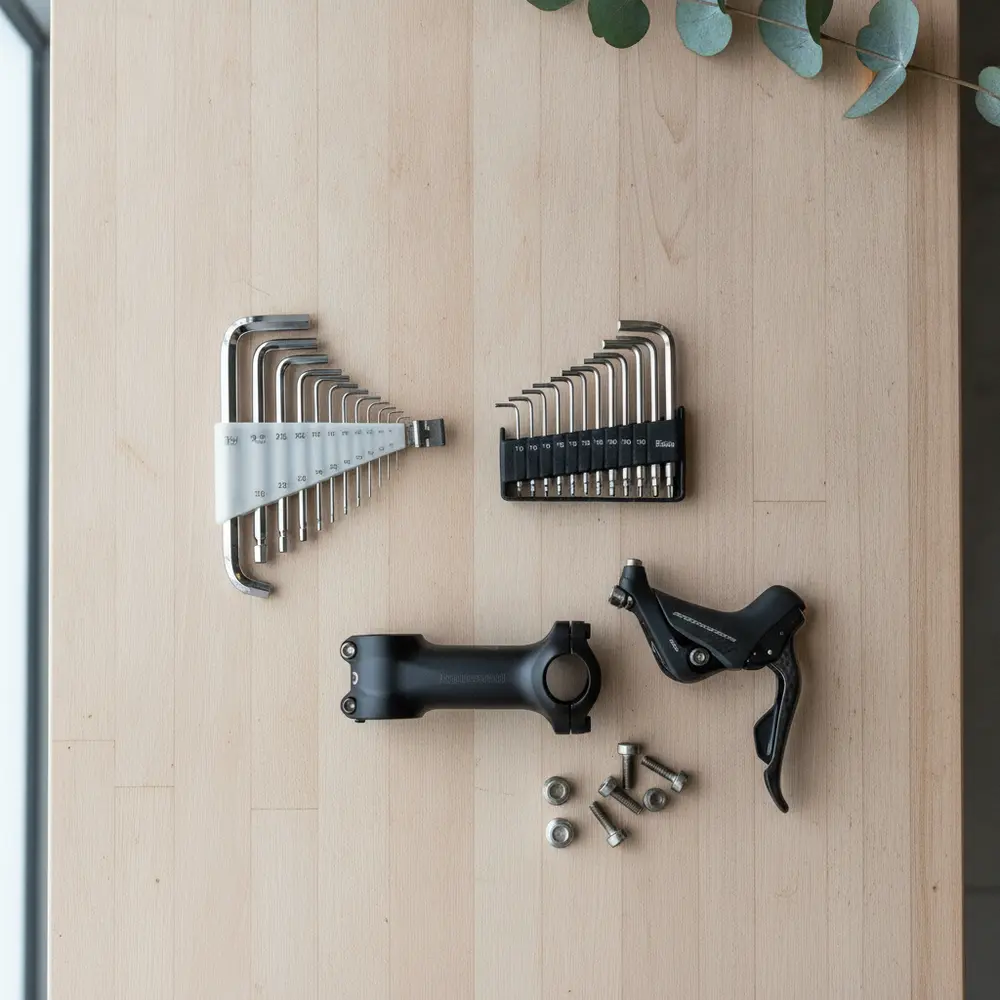
If you only ever own two types of tools for your bike, make them Allen keys and Torx keys. Between them, they cover the vast majority of bolts you will ever touch on a modern road, gravel, or mountain bike.
By the end of this article you will know exactly which sizes to buy, what each one is for, how to choose a set that will not strip your bolts, and where to pick one up in Australia without overpaying.
Note for Australia:
- Most Allen key and Torx sets sold in Australia are metric, which is correct for bikes. Avoid any imperial (SAE) hex sets unless specifically needed for older American-made components.
- Local retailers like Pushys, Anaconda and your local bike shop all stock suitable sets. You do not need to import from overseas.
- Under the Australian Consumer Law, tools sold here must be of acceptable quality. If a cheap set rounds off on the first use, you have grounds for a refund or replacement from an Australian retailer.
At a glance:
- Allen (hex) keys and Torx keys cover almost every bolt on a modern bike.
- The sizes you genuinely need are fewer than you think: 2mm to 8mm Allen, plus T10, T20, T25 and T30 Torx.
- Material quality matters. Soft steel rounds bolt heads. Chrome vanadium or S2 steel are the minimum worth buying.
- A ball-end Allen key is useful for awkward angles, but always finish with a straight-end key for final torque.
Key takeaways:
- The 4mm and 5mm Allen keys are the two sizes you will reach for most on any bike.
- T25 Torx is the most important Torx size on modern disc brake bikes, covering most rotor bolts.
- Cheap hex key sets are a false economy, especially on aluminium or carbon bolt heads.
Why Allen Keys and Torx Keys Are the Most-Used Tools in Any Cyclist's Kit
Walk into any bike workshop and you will see one thing clearly: the Allen key set is the most-used tool on the bench. Modern bikes use hex (Allen) socket bolts almost everywhere because they are compact, strong, and easy to torque accurately. Torx fasteners have become increasingly common too, especially on disc brake components and electronic groupsets.
Understanding why each type exists helps you use them correctly. Allen bolts have a six-sided recess and are measured in millimetres across the flats. Torx bolts have a six-pointed star recess and are measured by a T-number. Both designs give a better mechanical grip than slotted or Phillips-head screws, which is why the bike industry moved to them.
The Difference Between Allen (Hex) Keys and Torx Keys
Allen keys are the standard for structural bolts: stems, handlebars, seatposts, bottle cages, brake lever clamps. Torx fasteners handle components where precise torque or vibration resistance matters, such as disc rotors, rotor spiders, some derailleur pivots, and cleat bolts on certain shoe systems.
A useful way to think about it: if the bolt holds something structural, it is probably Allen. If it is on a braking component or an electronic system, it is likely Torx. In practice you need both, and neither type is interchangeable with the other.
Which Allen Key Sizes You Actually Need for a Bike
You do not need a 30-piece set to maintain a bike. Most home mechanics genuinely use five or six Allen key sizes the vast majority of the time. The rest come up occasionally or not at all on most builds.
If you are just getting started with building your home bike workshop, start with the sizes listed below and add others only as you encounter them on your specific components.
The Most Common Allen Key Sizes and What They Tighten
Here is an honest breakdown of which sizes earn their place in a cycling tool kit, based on the bolts you will actually encounter.
- 2mm: Small adjustment screws, some cleat micro-adjustment bolts, Di2 port covers on older Shimano systems.
- 2.5mm: Some cleat bolts, small accessory mounting screws, Garmin and computer mount bolts on certain brands.
- 3mm: Cleat bolts on most road cycling shoes including Shimano and Look, brake pad positioning bolts, some cable anchor bolts.
- 4mm: The single most-used size on a modern bike. Stem bolts, brake lever clamps, bottle cage bolts, handlebar accessory mounts, saddle rail clamps on many seatposts.
- 5mm: Seatpost binder bolts, some stem face plate bolts, SPD cleat bolts, handlebar clamp bolts on some stems, quick release and thru-axle lever bolts.
- 6mm: Crank bolts on some systems, stem steerer clamp on many forks, larger seatpost collar bolts.
- 8mm: Crank arm fixing bolts on older square taper and some external bearing systems, suspension pivot bolts on MTB.
The 4mm is genuinely the workhorse. If you ride a modern road or gravel bike and only had one Allen key, the 4mm would get you furthest. The complete bike tool checklist on Segment Club covers these sizes in context if you want a broader workshop overview.
Which Torx Sizes Matter for Modern Bikes
Torx has become far more common on bikes over the past decade. If you ride a bike with disc brakes, you already have Torx bolts. If you run electronic shifting, you almost certainly have Torx fasteners on your system somewhere.
The good news is that you only need four Torx sizes to cover nearly everything on a modern bike. According to Park Tool's bike repair guides, having the correct tool size for Torx fasteners is especially important because the star profile rounds off more easily than hex when the wrong size is forced.
Where Torx Bolts Show Up on Road, MTB and Gravel Bikes
- T10: Small screws on electronic shifting components, port covers on Shimano Di2 junction boxes, some cleat adjustment bolts.
- T20: Some brake pad retaining bolts, small disc rotor bolts on certain systems, chain guide bolts on MTB.
- T25: The most important Torx size for disc brake cyclists. Most disc rotor spider bolts and some rotor lockring interfaces across Shimano, SRAM and TRP use T25. Also used for some thru-axle skewer bolts and derailleur hanger bolts.
- T30: Larger rotor mounting bolts on some systems, some suspension linkage bolts on MTB, chainring bolts on certain mountain and gravel groupsets.
If you ride a disc brake bike and do not have a T25 Torx in your kit, you are missing the one Torx size that matters most. The T25 is worth keeping both at home and in your on-bike multi-tool setup.
Allen and Torx Quick Reference Table
| Size | Type | Most Common Use | Also Useful For |
|---|---|---|---|
| 2mm | Allen | Small adjustment screws | Di2 port covers, accessories |
| 2.5mm | Allen | Cleat micro-adjust, computer mounts | Small accessory bolts |
| 3mm | Allen | Road cleat bolts (Shimano, Look) | Brake pad adjustment |
| 4mm | Allen | Stem bolts, brake lever clamps, bottle cages | Saddle rail clamps, bar mounts |
| 5mm | Allen | Seatpost binder, SPD cleats | Stem face plates, thru-axle levers |
| 6mm | Allen | Stem steerer clamp, some crank bolts | Larger seatpost collars |
| 8mm | Allen | Crank arm fixing bolts | MTB suspension pivot bolts |
| T10 | Torx | Electronic shifting components | Port covers, small cleat bolts |
| T20 | Torx | Brake pad retaining bolts | Small rotor bolts, chain guides |
| T25 | Torx | Disc rotor spider bolts | Derailleur hanger bolts, thru-axle bolts |
| T30 | Torx | Larger rotor and suspension bolts | MTB chainring bolts |
Ball-End vs Standard Allen Keys - Does It Matter for Bike Work
Ball-end Allen keys have a rounded tip that lets you drive a bolt at an angle, usually up to around 25 to 30 degrees off-axis. This is genuinely useful on a bike where access is tight, such as reaching a bottle cage bolt behind a frame tube or a clamp bolt tucked behind a cable.
The trade-off is torque. Ball-end tips transfer less force to the bolt than a straight-end key, and they are more likely to slip or round off the bolt head under high load. As a general rule, use the ball end to get the bolt started or for low-torque work, then switch to a straight-end key to tighten to the final torque value.
For carbon components in particular, this matters. You should be using a torque wrench for final tightening on carbon anyway, but always start with a straight key and never crank a ball-end key hard into a bolt you care about. The Wera hex key range is a good reference point for understanding how quality manufacturers document the correct use angles for ball-end keys.
What to Look for When Buying a Set
Material is the most important factor. Look for chrome vanadium (Cr-V) steel or S2 steel as a minimum. These alloys are hard enough to bite into a bolt head without deforming. Soft steel hex keys will round off bolt heads, especially on aluminium or titanium fasteners, and once you have rounded a bolt head on a carbon frame you will understand why quality matters.
Fold-out L-key sets are convenient and compact for a workshop bench. T-handle sets give better torque leverage and are faster for repetitive tasks like adjusting multiple bolts. A fold-out set is often the best starting point for home mechanics because it keeps all your sizes in one place and is less likely to roll off the bench.
For Torx keys, the same material rules apply. Avoid anything that feels light and cheap in your hand. The star profile on Torx fasteners can strip if the key is slightly undersize or made from soft metal, and Torx bolts on disc rotors are ones you absolutely do not want to strip.
Australian Retailers and What to Expect to Pay
You have solid options locally without needing to order from overseas. Here is a rough guide to where and what to look for.
- Pushys.com.au: Stocks cycling-specific hex and Torx sets from Birzman, Lezyne, Topeak and Pedro's. Good range of mid-tier cycling tool sets. Check their hex and Torx keys section for current pricing and availability.
- Anaconda and Repco: Carry general-purpose hex key sets. Often well-priced for Cr-V sets that work fine for most bike tasks. Not cycling-specific, but the bolts do not care.
- Local bike shops: Stock bike-specific sets and can advise on what works with your components. Worth the conversation if you are unsure.
- Budget to expect: A decent Cr-V fold-out Allen key set runs roughly $20 to $50 from a local retailer. Torx sets in a similar quality range sit around $15 to $40. Premium brands like Wera or PB Swiss cost more but last considerably longer.
How to Use Them Without Stripping Bolts or Rounding Heads
Using Allen and Torx keys correctly is straightforward once you know the basics. Most stripped bolts happen because the wrong size key was used, the key was worn, or too much force was applied at the wrong angle.
Follow these habits and you will save yourself a lot of grief.
- Always use the correct size. If the key feels loose in the bolt, stop and find the right one.
- Push the key fully into the socket before applying any torque. A half-inserted key is how bolt heads get rounded.
- For carbon frames and components, use a torque wrench for final tightening. The numbers on the spec sheet are there for a reason.
- Keep your keys clean. Grit inside a bolt socket plus a dirty key is a recipe for rounding.
- If a bolt is seized, apply a penetrating lubricant and wait before forcing it. Forcing a seized bolt with an Allen key destroys both the bolt and sometimes the key.
Common Mistakes
- Using a ball-end key to apply full torque, especially on stem or seatpost bolts.
- Buying a cheap set, rounding a bolt head on a carbon frame, then spending more money on extraction tools than a quality set ever cost.
- Using a worn or slightly undersize Torx key on rotor bolts. If the key wobbles at all, do not proceed.
- Ignoring torque specs on carbon components. Finger-tight plus a bit is not a torque spec.
- Not checking whether a bolt is Allen or Torx before reaching for a tool. They look similar when greasy.
- Storing keys loose in a toolbox where they get nicked and corroded. A fold-out set or a keyed holder keeps them in better condition.
If You Are New to Home Bike Maintenance
- Start with a fold-out Allen key set covering 2mm to 8mm, and a basic Torx set with at least T25 and T30.
- Identify your most-used bolts before buying anything else. Look at your stem, bar clamp, bottle cages and seatpost first.
- Read the torque specs in your component manuals. Most manufacturers list them on their websites or dealer documentation.
- Do not crank bolts as hard as you can. Most bike bolts spec at modest torque values, and overtightening cracks carbon and strips threads.
- Consider the beginner bike maintenance guide on Segment Club as a useful starting point alongside your tool kit.
If You Have Already Done Basic Maintenance
- Upgrade to a Cr-V or S2 steel set if you are still using a budget set that came with your bike. The difference is noticeable on tight bolts.
- Add a T-handle set for sizes you use regularly, especially 4mm and 5mm Allen. The extra leverage and speed is worth it.
- Pair your Allen and Torx keys with a quality torque wrench if you work on carbon components. This is the single biggest upgrade for accuracy and safety.
- Pick up T10 if you run Shimano Di2 or SRAM eTap, and T25 if you have disc brakes. These are the Torx sizes electronic and disc brake systems use most.
- Keep a second compact set in your workshop bag for trackside or group ride mechanical assistance.
Frequently asked questions
What is the most important Allen key size for a cyclist to own?
The 4mm Allen key is the single most-used size on a modern bike. It covers stem bolts, brake lever clamps, bottle cage bolts, handlebar accessory mounts and saddle clamps on many seatposts. If you only carry one size, carry the 4mm.
Do I really need Torx keys or can I get by with just Allen keys?
If you ride a disc brake bike, you need Torx keys. Rotor bolts on most modern disc systems use T25, and you cannot work around that with an Allen key. Electronic groupset users also benefit from T10. For rim brake bikes with traditional components, Allen keys alone cover most tasks.
Are ball-end Allen keys safe to use on bike bolts?
Ball-end keys are useful for accessing bolts at awkward angles, but they should not be used for final torque tightening. At high torque the ball tip can slip and round the bolt socket. Use the ball end to start and position the bolt, then switch to a straight-end key to finish tightening.
What material should I look for in a hex key set?
Chrome vanadium (Cr-V) or S2 steel are the minimum worth buying for bike work. These materials are hard enough to grip bolt heads without deforming under normal torque values. Avoid sets that do not specify their steel grade, as they are usually made from mild steel that rounds off quickly on tight bolts.
Can I buy a good Allen and Torx key set in Australia without spending a lot?
Yes. A solid Cr-V fold-out Allen key set is available at Anaconda, Repco, Pushys and most local bike shops for a reasonable price. You do not need to pay premium brand prices for home workshop use, but do avoid the absolute cheapest no-name sets. Mid-range sets from known brands do the job for most riders and are covered by Australian consumer guarantees if they fail prematurely.
Quick summary
- Allen keys cover most structural bolts on a bike. The 4mm and 5mm are your most-used sizes.
- Torx keys are essential for disc brake and electronic shifting components. T25 is the one size you must have.
- Ball-end keys help with access but should not be used for final torque on any bolt.
- Buy Cr-V or S2 steel as a minimum. Cheap sets round bolt heads and cost more in the long run.
- Australian retailers stock what you need locally. You do not need to order overseas to get a quality set.
This is educational content, not financial advice.