There are few things more frustrating than heading out for a ride and having your gears skip, hesitate, or refuse to shift cleanly. The good news is that the vast majority of shifting problems come down to a small handful of causes, and most of them are well within reach of any rider with basic tools and 20 minutes to spare.
Work through this guide and you will be able to diagnose your specific shifting symptom, make the right adjustment in the right order, and get back on the road or trail with confidence. We cover both rear and front derailleur setups, and the process applies to Shimano, SRAM, and Campagnolo mechanical groupsets.
Note for Australian riders:
- Red dirt, coastal salt air, and summer heat all accelerate cable and housing wear faster than milder climates. Check your cables more often than the general advice suggests.
- If you ride near the coast or in dusty inland conditions, stainless steel cables are worth the small price premium for better corrosion resistance.
- Most Australian bike shops carry replacement cables and housing, and online retailers can get parts to you quickly if you plan ahead.
At a glance:
- Most shifting problems are caused by cable stretch, worn housing, or a bent derailleur hanger.
- Always start at the barrel adjuster before touching limit screws.
- A worn chain can cause indexing problems even on a perfectly adjusted derailleur.
- Know when to stop and visit a mechanic. Some fixes genuinely need a professional.
Key takeaways:
- Cable tension is the first thing to check and the easiest thing to fix.
- Limit screws control the physical travel range of your derailleur, not the indexing fine-tune.
- A bent derailleur hanger is a common culprit that cable adjustments will never fully fix.
Why Gear Shifting Problems Happen (and Why They're Usually an Easy Fix)
Shifting problems almost always come back to one of three things: cable tension, component wear, or physical alignment. If your bike was shifting well and then gradually got worse, cable stretch is the most likely cause. If it was never quite right after a crash or a rough trail ride, a bent derailleur hanger is worth checking first.
The good news is that none of these diagnoses require specialist training. You just need to know where to look and what order to check things in. Jumping straight to the limit screws when the real issue is cable tension is one of the most common mistakes home mechanics make, and it usually makes things worse.
The Most Common Culprits Behind Poor Shifting
- Cable stretch - the most common cause of indexing that slowly drifts out over time.
- Worn or kinked housing - cracked or compressed housing causes inconsistent cable tension, especially in wet or dusty conditions.
- Bent derailleur hanger - particularly common on mountain bikes after a fall or a hard knock. The hanger is designed to bend instead of the frame.
- Chain wear - a stretched chain causes skipping and poor indexing even on a perfectly adjusted derailleur. Check your chain wear regularly.
- Dirty or dry drivetrain - grit and grime increase friction in the cable housing and between chain and cassette. Clean the drivetrain before adjusting anything.
- Bent derailleur cage - less common but possible after a crash. This is usually a shop job.
What You'll Need Before You Start
You do not need a full workshop to sort most shifting issues. If you do not have a bike stand, flip the bike upside down on a flat surface or lean it against a wall. Many Aussie riders do this on the back porch or in the garage, and it works fine for cable tension and limit screw adjustments.
| Tool | What It's Used For | Essential? |
|---|---|---|
| Phillips and flathead screwdrivers | Limit screw adjustment | Yes |
| 2mm, 4mm, 5mm Allen keys | Cable pinch bolts and derailleur mounting | Yes |
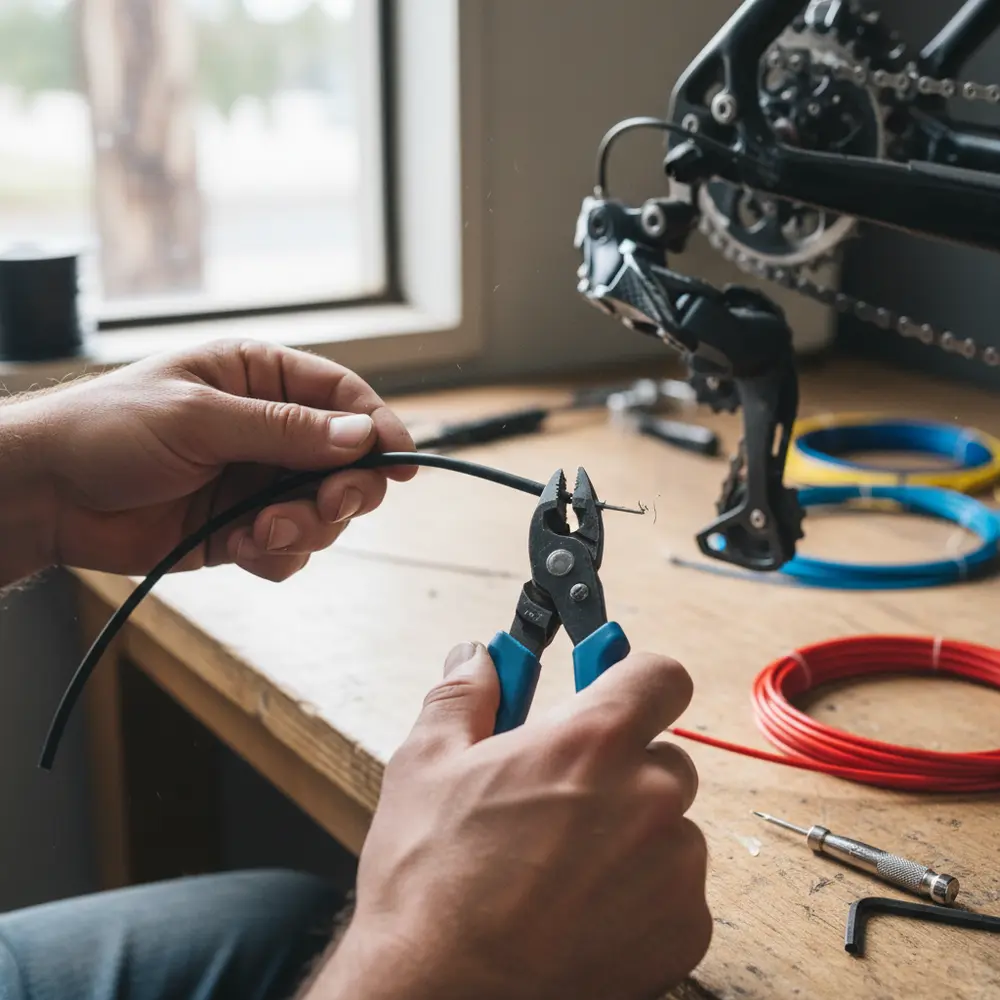
| Cable cutters | Clean cable and housing cuts | If replacing cables |
| Chain wear indicator tool | Checking chain stretch | Recommended |
| Hanger alignment gauge | Checking derailleur hanger straightness | Optional, can borrow from shop |
| Lubricant and clean rag | Drivetrain cleaning before adjustment | Yes |
For groupset-specific torque specs and cable routing diagrams, the Shimano technical documentation library is a useful reference for Shimano-equipped bikes.
Step 1 - Inspect the Cable and Housing
Before touching any adjustment screws, give the cable and housing a proper look. Run your fingers along the full length of the housing and feel for any kinks, cracks, or sections that feel compressed. Pull the cable gently at the derailleur end to check for any fraying near the pinch bolt.
This step matters because no amount of barrel adjuster tweaking will fix a problem caused by damaged housing. The housing needs to transmit cable tension consistently along its full length. If it is compressed or cracked, the tension will be unpredictable.
Signs Your Cable or Housing Needs Replacing
- Visible fraying at the pinch bolt, the shifter entry, or anywhere along the cable run.
- Housing that is kinked, cracked, or has a flat spot where it contacts a frame stop.
- Rust or corrosion visible on the cable inner wire.
- Shifting that feels spongy or requires extra force at the lever.
- A new cable that has had a few rides and now shifts slightly out of index. This is normal bedding-in stretch and a quick barrel adjuster tweak will sort it.
If you do need to replace cables, stainless steel inners are worth using in Australian coastal or dusty conditions. For a practical overview of the replacement process, Bicycle Network Australia's bike maintenance guide covers the basics in plain language for local riders.
Step 2 - Check and Adjust Cable Tension
Cable tension is where you start every adjustment. It is the fine-tune of your indexing, and getting it right before touching anything else will save you a lot of frustration. If the cable tension is off, the derailleur will not land precisely on each cog no matter how well the limit screws are set.
Shift to the smallest rear cog (highest gear) and the middle chainring up front. This is your baseline position. The cable should have a little tension, but should not be under load. Now pedal (spin the rear wheel if the bike is upside down or on a stand) and try shifting up through the gears one click at a time.
Using the Barrel Adjuster to Fine-Tune Indexing
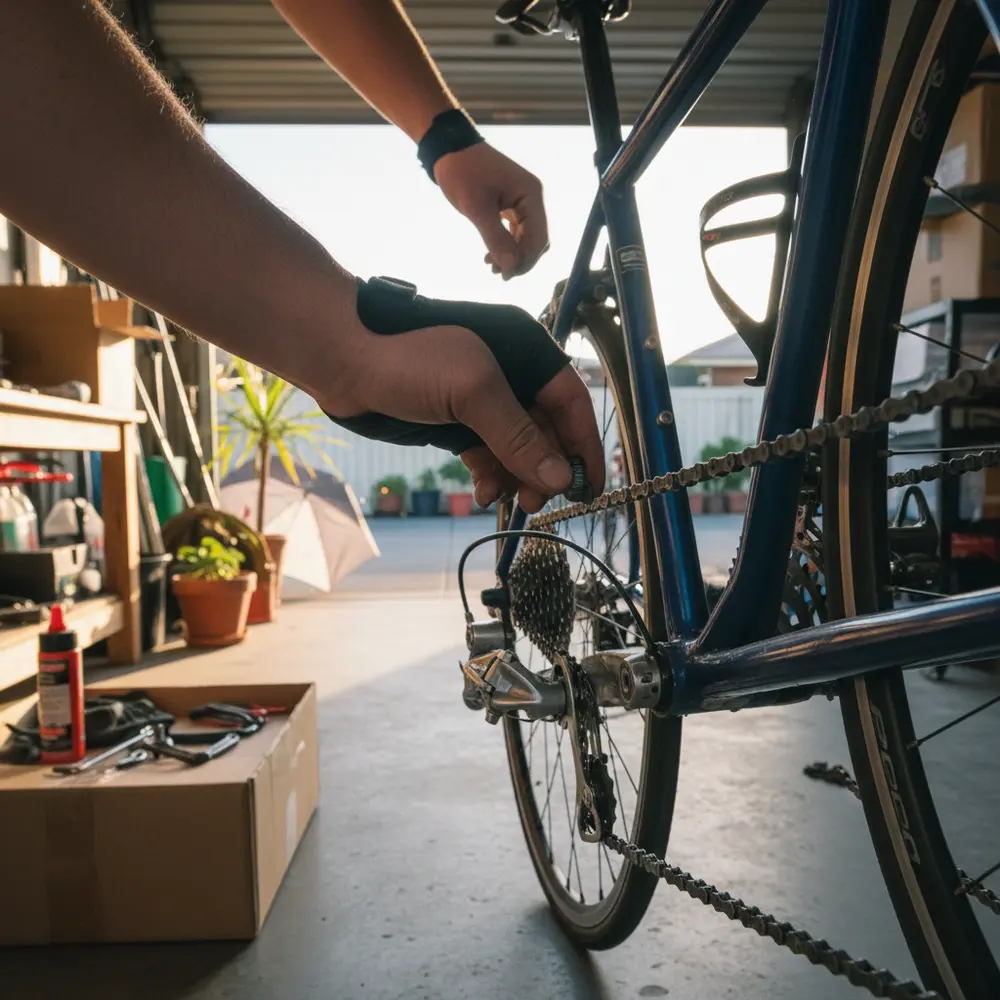
The barrel adjuster is the cylindrical dial where the cable housing meets the derailleur or the shifter. Turning it anti-clockwise (loosening it out) increases cable tension and helps the derailleur move toward larger cogs. Turning it clockwise decreases tension and lets the derailleur move toward smaller cogs.
- Chain slow to shift to a larger cog (harder to pedal): Turn the barrel adjuster anti-clockwise by a quarter turn at a time.
- Chain slow to shift to a smaller cog (easier to pedal): Turn the barrel adjuster clockwise by a quarter turn at a time.
- Ghost shifting or chain wandering between cogs: Often a cable tension issue combined with chain wear. Check cable tension first, then check chain condition.
Work through the whole cassette range after each adjustment, shifting up and down. You are listening for clean, positive clicks and no hesitation or chain noise between gears. For a visual demonstration of this process, the GCN gear indexing video guide is worth watching before you start.
Step 3 - Set Your Limit Screws (H and L)
Limit screws define the physical boundaries of derailleur travel. They stop the chain from being thrown off the outside of the smallest cog (H screw) or dropping off the inside of the largest cog (L screw). They are not indexing adjustments. If your indexing is off, go back to cable tension. Limit screws only need attention if the chain is physically over-shifting or under-shifting at the extremes.
Rear Derailleur Limit Screw Adjustment
Shift to the smallest cog at the rear and look at the derailleur from behind. The upper pulley should be aligned directly below the smallest cog. If it sits outboard of the cog, the H screw needs tightening (clockwise). If it cannot reach the smallest cog, loosen the H screw slightly.
For the L screw, shift to the largest cog and check alignment in the same way. The pulley should sit directly below the largest cog. Adjust in small quarter-turn increments and test each time. For a detailed walkthrough, Park Tool's guide on rear derailleur adjustment is the most thorough free resource available.
Front Derailleur Limit Screw Adjustment
The front derailleur L screw prevents the chain from dropping to the inside (between frame and small chainring), and the H screw stops the chain from over-shifting to the outside on the large chainring. Shift to each extreme and check that the chain clears the inner and outer cage walls by roughly 1mm to 2mm without rubbing.
If the cage height or angle looks off, the cage should sit roughly 1mm to 3mm above the large chainring teeth and run parallel to the chainrings. This is worth checking before touching limit screws if your front shifting has never been quite right.
Step 4 - Check Derailleur Alignment and Hanger Straightness
If you have gone through cable tension and limit screws and the shifting still will not behave, look at the derailleur hanger. A bent hanger is one of the most common causes of stubborn shifting issues that do not respond to normal adjustments, and it is easy to miss at a glance.
Stand directly behind the bike and look at the rear derailleur. In the ideal position, the derailleur cage should hang parallel to the cassette and perpendicular to the ground. Even a slight bend will push the derailleur out of alignment with the cogs and make indexing inconsistent across the cassette range.
- A hanger alignment gauge is the most accurate way to check. Many local bike shops will lend or rent one.
- Visual inspection from behind the bike can catch obvious bends, but subtle bends require a gauge.
- Aluminium hangers can be carefully bent back, but they can become brittle if bent multiple times. Replacement is cheap, around $10 to $30 for most bikes.
- Hangers are designed to be sacrificial. They bend to protect the more expensive frame dropout.
For mountain bike riders in particular, this is worth checking after any crash or hard off-trail contact. The Singletracks guide on derailleur hanger alignment covers the visual check and gauge process clearly.
Shifting Symptom Troubleshooting Flow
Use this quick decision path to match your symptom to the right fix. Work through it in order before jumping to more complex adjustments.
- Chain skips under load on one or two specific cogs - Check chain wear first. A worn chain will skip on certain cogs even with perfect adjustment. If the chain is fine, check cable tension.
- Slow or hesitant to shift to a larger cog - Increase cable tension using the barrel adjuster (anti-clockwise). Clean and lube the drivetrain if it has not been done recently.
- Slow or hesitant to shift to a smaller cog - Decrease cable tension (clockwise on the barrel adjuster). Check housing for kinks or damage.
- Ghost shifting (chain moves between cogs without input) - Cable tension is the likely cause. May also be a worn chain or housing issue. Check both.
- Chain throws off the extreme ends of the cassette - Limit screws need adjustment. Set cable tension correctly first, then set H and L screws.
- Shifting is inconsistent across the whole cassette range and will not respond to barrel adjuster - Check the derailleur hanger alignment. This symptom often means the hanger is bent.
- Front derailleur not reaching the large chainring - Check cable tension and cage height. The cage should sit 1mm to 3mm above the large chainring teeth.
- Chain rubs front derailleur cage in certain gear combinations - Use the trim function on your shifter if available. Some cross-chain combinations will always cause mild rub. Avoid extreme cross-chaining as a habit.
Common Mistakes When Adjusting Gears
- Touching limit screws before sorting cable tension - Always fix cable tension first. Limit screws are a boundary setting, not an indexing adjustment.
- Making large adjustments at once - Quarter turns are the rule. Big adjustments overshoot the mark and create new problems.
- Forgetting to check the drivetrain condition - A dirty or worn drivetrain will not shift cleanly no matter how well adjusted it is. Check chain wear with a chain wear tool. Chain stretch causes indexing problems even on a perfectly set-up derailleur.
- Skipping the cable and housing inspection - Damaged housing will give you inconsistent results that look like an adjustment problem.
- Not re-checking after a few rides - New cables bed in and stretch slightly. A quick barrel adjuster tweak after the first two or three rides on new cables is normal.
- Assuming it is a cable issue when the hanger is bent - If adjustments do not hold, check the hanger before replacing cables.
If You Are New to Adjusting Gears
- Start with the barrel adjuster only. It is safe, reversible, and solves most common indexing problems.
- Do not touch the limit screws until you understand what they do. Incorrect limit screw adjustment can cause the chain to derail completely.
- Clean the drivetrain before adjusting anything. Grit in the system gives you false results.
- Work in a well-lit space and take your time. There is no rush. Quarter turns, then test.
- If in doubt, a local bike shop or the Segment Club community can point you in the right direction without judgement.
If You Have Done This Before
- If the barrel adjuster is fully wound in or out and cannot bring the indexing into range, the cable tension at the pinch bolt needs resetting from scratch.
- Check the B-screw if you are getting poor shifting on the larger cogs of the cassette. The B-screw sets the gap between the upper pulley and the cassette sprockets.
- For electronic groupsets like Shimano Di2 or SRAM AXS, limit screw adjustment is broadly similar to mechanical, but indexing is handled by the firmware rather than cable tension. Consult your groupset's specific setup guide for differences.
- If you are rebuilding from scratch with a new cable, set the barrel adjuster to roughly two to three turns out from fully wound in before threading the cable through the pinch bolt. This gives you adjustment range in both directions.
- A hanger alignment gauge is worth owning if you ride off-road regularly. Most frames use a replaceable hanger and having a spare on hand is a good idea.
When a DIY Fix Will Not Cut It - Time to See a Mechanic
Most shifting issues are fixable at home, but there are situations where pushing on can cause more damage. Knowing when to stop is part of being a good home mechanic.
- The derailleur cage is visibly bent or twisted after a crash.
- The frame dropout (where the hanger attaches) is damaged or cracked.
- The rear derailleur itself is bent and a new hanger does not fix the alignment.
- The cassette or chainrings are worn to the point where even a new chain skips.
- Internal cable routing is inaccessible without specialised tools or knowledge.
- Electronic shifting system errors that require firmware updates or component replacement.
Keeping your bike in safe working order is also worth taking seriously from a safety standpoint. Australian road rules require bicycles to be in a safe and roadworthy condition when ridden on public roads and shared paths. A drivetrain that slips unpredictably under load is a genuine hazard.
Quick Pre-Ride Shifting Check Routine
Building a two-minute pre-ride habit will catch most issues before they turn into a problem mid-ride. Run through this before heading out.
- Spin the cranks and shift through the full rear cassette range. Listen for any hesitation or skipping.
- Shift through both chainrings on the front. Check for clean engagement and no chain rub.
- Visually check that the rear derailleur cage is straight and not dragging on anything.
- Check the cable run for any obvious kinks, particularly at the frame stops.
- If anything feels off, start with the barrel adjuster before leaving. A quarter turn often fixes a slightly out-of-index shift.
Frequently asked questions
Why are my gears skipping only under load when climbing?
This is most commonly a sign of chain wear. A stretched chain skips on specific cassette cogs when under load, even if the bike shifts fine on the flat. Use a chain wear indicator tool to check. If the chain is worn past the replacement threshold, a new chain is the fix, and possibly a new cassette if the wear is significant.
My gears shifted fine yesterday. Why are they off today?
Temperature changes can affect cable tension slightly, and cables do stretch gradually over time. If the shift is only slightly out, one or two quarter turns on the barrel adjuster will usually bring it back into index. If it is significantly out of adjustment overnight with no obvious cause, check for a kinked cable or housing that has shifted position.
Is it safe to adjust limit screws myself?
Yes, with care. Limit screws only need to be adjusted if the chain is physically over-shifting or under-shifting at the extremes of the cassette or chainrings. Make small quarter-turn adjustments and test each time. Get cable tension right first. Incorrect limit screw settings can cause the chain to derail, so work slowly and check after every change.
Do I need to adjust gears differently for Shimano versus SRAM?
The adjustment process for mechanical groupsets is broadly the same across Shimano and SRAM. The barrel adjuster, limit screws, and B-screw all function the same way. The main difference is the direction of shift lever operation. For electronic groupsets like Di2 or AXS, the indexing process is different and you should refer to the manufacturer's specific setup documentation.
How often should I replace gear cables in Australian conditions?
There is no fixed rule, but riding in coastal, dusty, or wet Australian conditions will wear cables and housing faster than riding in dry, sealed-road environments. Inspect cables visually every few months. Signs like fraying, stiff shifting, or visible corrosion mean it is time to replace. Many riders replace cables as part of a seasonal service. Stainless steel cables are worth using in harsh conditions for better longevity.
Wrapping Up
Gear shifting problems sound intimidating the first time, but they almost always trace back to a short list of fixable causes. Work through things in the right order and you will sort it faster than you think.
- Start with a clean drivetrain and a cable inspection before adjusting anything.
- Use the barrel adjuster for indexing. Leave the limit screws alone until cable tension is right.
- Check the derailleur hanger if adjustments are not holding or the shifting is inconsistent across the cassette.
- Know your chain wear. A worn chain is a common and overlooked cause of poor shifting.
- When the problem is beyond home repair, get to a mechanic before the next ride, not after.
For more bike maintenance tips and guides, head to the Segment Club blog. And if you want to talk through a specific shifting issue, get in touch with the Segment Club community and we will point you in the right direction.
This is educational content, not financial advice.