Recumbent bikes are one of cycling's most interesting detours, sitting well outside the mainstream but quietly building a loyal following among Australian riders who have tried them and never looked back. If you have ever finished a long ride with a sore neck, aching wrists, or a saddle that felt like a punishment, it is worth knowing there is another way to sit on a bike.
By the end of this article you will understand what recumbents actually are, how they compare to a standard road or commuter bike, who they genuinely suit in an Australian context, and what it realistically costs to get into one. You will have enough information to decide whether a test ride is worth your time.
Note for Australia:
- Recumbent bikes are legally classified as bicycles under Australian road rules, provided they meet standard lighting and reflector requirements. Always check your state's specific road rules as implementation varies slightly across jurisdictions. See the Australian Road Rules for the national framework.
- Recumbent trikes are wider than standard bikes and may have restricted access on some shared paths. Check local council guidelines before heading onto a narrow shared path.
- Visibility is a genuine safety concern. Most recumbent trike riders in Australia fit a tall safety flag so that drivers in larger vehicles can see them. This is strongly recommended, not optional.
At a glance:
- Recumbents offer real aerodynamic and comfort advantages over upright bikes, especially on flat terrain and long days in the saddle.
- Two-wheeled recumbents have a learning curve. Expect a few rides before you feel settled.
- New recumbents in Australia range from roughly $2,000 AUD at the entry level to well above $5,000 AUD for quality mid-range and performance models.
- Second-hand options exist but the market is thin. Patience and flexibility on brand help a lot.
Key takeaways:
- Recumbents are not a gimmick. The aerodynamic and comfort case is backed by evidence and genuine rider experience.
- They are not right for everyone. Hills, storage, and visibility are real trade-offs to weigh up honestly.
- The Australian recumbent community is small but active, with HPV events and online forums where you can get real local advice.
What Is a Recumbent Bike?
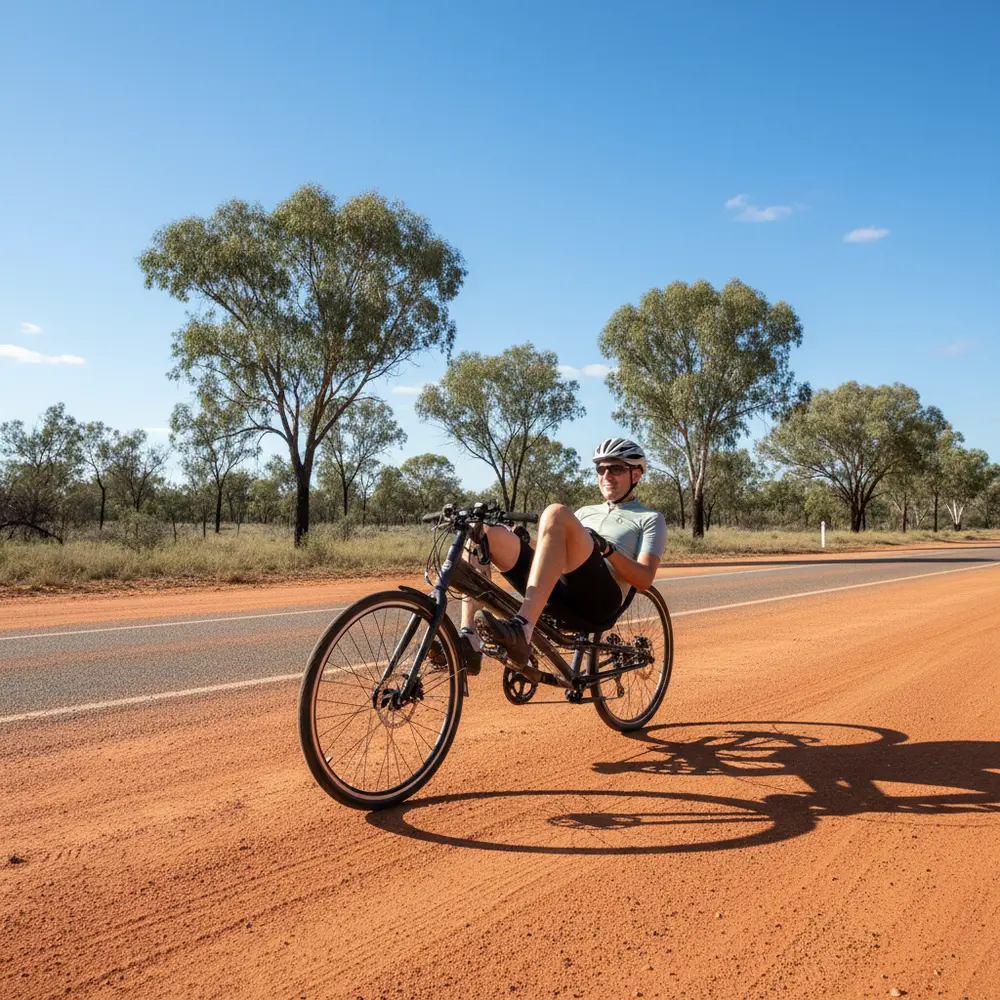
A recumbent bike is a bicycle where you sit in a reclined position with your legs extended out in front of you rather than underneath you. Instead of perching on a narrow saddle and leaning forward over handlebars, you sit in a seat that supports your back, and your feet reach the pedals ahead of you. The result looks unusual the first time you see one, but it is a completely logical approach to human-powered transport.
The recumbent position puts the rider's body closer to horizontal than vertical. This dramatically reduces the frontal area the rider presents to the wind, which is the main reason recumbents are aerodynamically faster than upright bikes at the same power output on flat ground.
How the Riding Position Works and Why It Matters
On a standard road bike, much of your weight goes through your hands, wrists, and a small saddle contact point. On a recumbent, your back is supported by a full seat, your weight is spread across your backside and back, and your hands rest lightly on low-set or above-shoulder handlebars with very little downward pressure. For riders dealing with wrist soreness, neck strain, or lower back pain on long rides, this is not a minor comfort upgrade. It changes the experience significantly.
Peer-reviewed research on spinal muscle activity during recumbent cycling confirms that the recumbent position reduces lumbar spine loading compared to a forward-leaning upright position. The clinical evidence is not overwhelming in volume, but what exists points in a consistent direction.
Types of Recumbent Bikes Available in Australia
Before you start shopping, it helps to know what you are actually choosing between. The category is broader than most people expect.
Two-Wheelers, Trikes, and Long-Wheel-Base vs Short-Wheel-Base
The main split in the recumbent world is between two-wheeled bikes (often called "bents") and three-wheeled trikes. Within two-wheelers, the next key distinction is wheel-base length.
| Type | Stability | Speed Potential | Learning Curve | Storage |
|---|---|---|---|---|
| Long Wheel Base (LWB) two-wheeler | More stable feel at low speed | Good on flats | Moderate. A few rides to adjust | Longer than a standard bike |
| Short Wheel Base (SWB) two-wheeler | Nimbler but twitchier to learn | Often faster than LWB | Steeper. Can feel unstable early on | More compact than LWB |
| Recumbent Trike (tadpole or delta) | Cannot fall over. Very stable | Slightly slower due to width and weight | Almost none. Very accessible | Widest option. Needs garage space |
Tadpole trikes have two wheels at the front and one at the rear. Delta trikes have one wheel at the front and two at the rear. Tadpole designs are the more common style sold in Australia today and are generally considered more stable at speed.
If you are coming back to cycling after an injury, or you are simply not interested in the balancing challenge, a recumbent trike is the most accessible starting point. CyclingAbout's recumbent touring guide covers the practical implications of each type for long-distance riding in useful detail.
The Real Advantages of Riding Recumbent
Aerodynamics, Comfort, and Back or Neck Pain Relief
The aerodynamic case for recumbents is well established. At speeds above roughly 25 to 30 km/h on flat terrain, the reclined position reduces air resistance enough to make a measurable difference in speed for the same effort. This is why recumbent streamliners hold the outright human powered land speed records. The Human Powered Vehicles Association of Australasia runs events where this advantage plays out in practice on Australian courses.
For everyday riders, the more relevant advantage is comfort. A full day in the saddle on an upright bike leaves most people with at least one of the following: saddle pressure, wrist ache, or neck stiffness from holding a forward position. A recumbent removes all three because your weight goes through your back and seat, not your hands or perineum. Many riders who switched to recumbents for pain relief end up staying because they simply enjoy riding more.
- No pressure on wrists or hands during long rides.
- No narrow saddle contact point. Lower back and sit bones are supported by a full seat.
- Neck stays in a natural position. No craning forward to see ahead.
- Aerodynamic advantage is real and grows with speed on flat roads.
- Can be a better fit for riders returning from injury or managing chronic pain.
The Trade-Offs You Need to Know About
Climbing, Visibility, Learning Curve, and Storage
It would be dishonest to talk up recumbents without being straight about the downsides. There are a few genuine ones that matter to Australian riders.
Climbing is harder on a recumbent. On an upright bike you can stand on the pedals and use your body weight. On a recumbent you are always seated, so steep climbs rely entirely on leg strength and gearing. Experienced recumbent riders compensate with lower gearing and a steady pace. It works, but you will be slower on hills than you are on an equivalent upright setup.
Visibility is a non-negotiable concern, particularly for trikes. You are lower to the ground than a standard cyclist, which makes it harder for drivers to see you at intersections and in traffic. A brightly coloured safety flag on a tall pole is standard practice among Australian recumbent trike riders and is strongly recommended for anyone riding on roads. Resources from Bicycle NSW cover broader cycling safety considerations that apply here too.
The learning curve for a two-wheeled recumbent is real. Balancing and steering feel different to an upright bike. Most new riders find it takes at least a few sessions, sometimes a week of short rides, before the handling feels natural. A recumbent trike has almost no learning curve since it cannot fall over.
Storage and transport are practical constraints. Recumbents are longer and sometimes wider than standard bikes. They do not fit standard bike racks without adapters and require a garage or large storage space. Apartment living and recumbent ownership is a difficult combination.
- Hills are slower. No standing out of the saddle is a real limitation.
- Low riding position means drivers may not see you as easily.
- Two-wheelers take time to learn. Do not expect to be comfortable on the first ride.
- Storage needs more space than a standard bike.
- Niche market means fewer local mechanics with recumbent-specific experience.
Who Actually Rides Recumbents in Australia?
HPV Events, Clubs, and the Australian Recumbent Scene
The Australian recumbent community is small but genuinely enthusiastic. It tends to attract riders who have done a lot of upright cycling and want something different, as well as riders who came to it through an injury or pain issue that made upright cycling unpleasant.
The HPV events in Australia organised by the Human Powered Vehicles Association of Australasia include endurance races such as the Maryborough 24-hour HPV race in Victoria. These events are open to a range of human powered vehicles including recumbents and velomobiles. They are a great way to see what the machines can do and to meet other riders in a relaxed environment.
Online, the Australian recumbent cycling community on Bicycles Network Australia is one of the better places to ask local questions about buying, riding, and maintaining a recumbent in Australian conditions. The forum is honest and experienced.
There is also a long-distance touring contingent. Australian riders have completed significant self-supported tours on recumbents, including routes across remote outback roads. The comfort advantage over a multi-week trip is significant. For that use case, see accounts of recumbent touring in Australia from riders who have done exactly that.
Where to Buy and What to Expect to Pay in Australia
This is where the niche nature of recumbents shows up most clearly. You cannot walk into a mainstream bike shop and pick one up. Most Australian sales happen through specialist importers, small dedicated dealers, or direct import arrangements.
As a rough guide to pricing for new bikes in the Australian market:
- Entry level (under $2,000 AUD): Very limited options at this price point. You might find an older or entry-grade model, but choices are narrow.
- Mid-range ($2,000 to $5,000 AUD): The practical sweet spot for most buyers. Decent components, reliable brands, and a machine that will last if maintained properly.
- High-end (above $5,000 AUD): Performance-focused models, velomobiles, and high-specification trikes. These are serious purchases for committed riders.
For second-hand options, second-hand recumbent bikes on Gumtree Australia are worth checking regularly. The market is thin and listings are infrequent, but prices are meaningfully lower than new. Facebook Marketplace is also worth monitoring. If you want to try before you buy, contact an HPV club member directly. Many are happy to let interested riders have a short go before committing.
On maintenance: the drivetrain and braking systems on most recumbents use standard bicycle components. A competent general bike mechanic can handle routine servicing. The frame geometry and idler pulley systems on some models may be unfamiliar, so it helps to find a mechanic willing to have a look before you need urgent repairs. If you have questions about finding a local mechanic or specialist, get in touch with us and we can point you in the right direction.
Is a Recumbent Bike Right for You? A Straightforward Guide
Work through the following decision points honestly. This is not a quiz with a right answer. It is a way to surface what actually matters to your situation.
- What is your main riding purpose? If you commute on roads with hills and need to keep up with traffic, a standard upright bike is likely more practical right now. If you tour, ride for fitness on flat terrain, or want to cover big distances in comfort, keep reading.
- Do you have an existing injury or chronic pain? Wrist, neck, and lower back issues that make upright cycling uncomfortable are the strongest reason to try a recumbent. A recumbent trike is worth a test ride before you make any decisions about giving up cycling.
- What is your budget? If you can only stretch to under $1,500 AUD, the second-hand market is your only realistic entry point and you will need patience. Between $2,000 and $5,000 AUD, you have genuine options for a new mid-range machine. Above $5,000 AUD, you are into purpose-built performance territory.
- Where will you store it? If you live in an apartment with no garage access, storage is a serious constraint. A standard upright bike fits more easily into small spaces. This alone rules out recumbents for many urban riders.
- Are you prepared for a learning curve? If you want to hop on and feel confident immediately, choose a recumbent trike. If you are open to spending a few sessions getting your balance and handling sorted on a two-wheeler, that option opens up too.
Common Mistakes to Avoid
- Buying without a test ride. Recumbents feel genuinely different to ride. Never commit to a purchase without sitting in the seat and turning the pedals, even if just for a few minutes.
- Underestimating the learning curve on a two-wheeler. New riders sometimes give up after one frustrating session. Give yourself at least a week of short rides before deciding it is not for you.
- Ignoring visibility on the road. Skipping the safety flag on a trike is a mistake, especially in Australian traffic conditions. Fit one from day one.
- Buying the cheapest option available. A poorly made recumbent will be harder to learn on and harder to maintain. A mid-range second-hand model is a better starting point than a cheap new one.
- Assuming any bike mechanic will know what to do with it. Most will manage fine with standard components, but it is worth having a conversation first, especially with idler pulleys or unusual frame mounts.
If You Are New to Recumbents
- Start with a recumbent trike if you want to skip the balancing challenge entirely and just experience the riding position.
- If you go for a two-wheeler, find a quiet car park or empty road for your first few sessions. Expect it to feel strange for at least two or three rides.
- Connect with the Australian recumbent cycling community through the HPVA before you buy. Club members can give you a realistic picture of what to expect locally.
- Check used recumbent bikes for sale on Gumtree before spending on a new model. A used entry-level machine is a low-risk way to find out if you like the style.
- Read up on different bike types on Segment Club to put recumbents in context with other alternatives.
If You Have Ridden Other Specialist Bikes Before
- The transition from a road bike to a recumbent is bigger than most specialist bike changes. Manage your expectations for the first few weeks.
- Your cardiovascular fitness transfers, but your muscle recruitment pattern changes noticeably. The glutes and quads work differently in the reclined position, particularly at the start of the pedal stroke.
- If you have done touring on an upright bike, the comfort gains on flat long-distance routes will be immediately obvious. The trade-off on climbs will also be obvious.
- Consider your current pain points on the bike. If you have none, the case for switching is weaker. If neck, wrist, or saddle pressure are regular issues, the case gets much stronger.
- Look at HPV race events as a way to test your fitness and enjoy the recumbent community before committing to a machine for everyday use.
Frequently asked questions
Are recumbent bikes legal to ride on Australian roads?
Yes. Recumbent bikes are classified as bicycles under Australian road rules provided they meet standard equipment requirements including lighting and reflectors. Recumbent trikes may face width restrictions on some shared paths. Check your state's specific road rules, as implementation varies slightly. The Australian Road Rules provide the national framework.
Is it true that recumbents are faster than road bikes on flat terrain?
The aerodynamic advantage is real and becomes meaningful at speeds above roughly 25 to 30 km/h on flat ground. At those speeds the reclined position significantly reduces your frontal area. On climbs, recumbents are generally slower than upright bikes because you cannot stand on the pedals. The net result depends heavily on the route.
Do recumbent bikes genuinely help with back and neck pain?
There is peer-reviewed evidence that the recumbent position reduces lumbar spine loading compared to a forward-leaning upright position. Many riders report significant relief from wrist, neck, and lower back pain after switching. It is not a guaranteed medical fix, but the physical reasons behind the improvement are well understood. If pain is driving your interest, a test ride is the best first step.
How long does it take to learn to ride a two-wheeled recumbent?
Most riders need several sessions over a week or two before the handling feels natural. The exact time varies. Some riders feel comfortable after two or three rides. Others take longer. A recumbent trike has almost no learning curve since it does not require balance in the same way. If you are concerned about the learning curve, start with a trike.
Where can I buy a recumbent bike in Australia?
Most sales go through specialist importers and small dedicated dealers rather than mainstream bike shops. For second-hand options, Gumtree Australia lists recumbents from private sellers and is the most active local classifieds source. Facebook Marketplace is also worth checking. Connecting with the HPVA community can also lead to private sales and demo opportunities.
Wrapping Up
Recumbents are a genuinely interesting option for Australian cyclists, not a novelty. Here is the short version of what to take away:
- The comfort and aerodynamic advantages are real and backed by evidence.
- The trade-offs on hills, visibility, storage, and learning curve are also real. Go in with clear eyes.
- A recumbent trike is the most accessible entry point, especially if injury or stability is a concern.
- The Australian market is niche but active. The HPVA community and second-hand platforms are the best starting points.
- A test ride before any purchase is non-negotiable. Find someone in the community willing to let you try one.
This is educational content, not financial advice.