Australia is one of the best countries in the world for multi-day cycle touring, but it also demands more of your bike and your planning than a weekend spin ever will. Get the wrong setup and you will feel it by day two, somewhere between a remote gravel section and the next town with a bike shop.
This article will help you understand what separates a proper touring bike from everything else, how Australian terrain and routes should shape your buying decision, and what to look for when you are ready to commit to a setup that will actually hold up out there.
Note for Australia:
- Bike shops in rural and outback Australia can be hundreds of kilometres apart. Self-sufficiency and repairability are not optional extras on an Australian tour.
- Australian touring routes range from smooth coastal highways to rough red-dirt tracks. Your tyre choice and tyre clearance matter more here than on a European tour.
- Heat, dust, and UV exposure put extra load on cables, tyres, and rubber seals. Factor in more frequent maintenance checks on longer trips.
At a glance:
- Touring bikes are purpose-built for carrying heavy loads over long distances on varied terrain.
- Steel frames remain a strong choice for Australian touring due to repairability in remote areas.
- Rack-and-pannier setups suit most multi-day trips better than bikepacking bags when you are carrying full camping gear.
- Your route type, load weight, and trip duration are the three factors that should drive your bike choice.
Key takeaways:
- A dedicated touring bike will outperform a road or gravel bike once your load exceeds about 15 to 20 kilograms.
- Geometry, gearing range, and mounting points matter far more than brand name when choosing a touring bike.
- Australia has world-class touring routes. Match the bike to the specific surfaces and distances you plan to ride.
What Is a Touring Bike and Why Does It Matter for Australian Riding
A touring bike is a bicycle designed from the ground up to carry heavy loads reliably over long distances. That sounds simple, but it has real implications for every part of the bike, from the frame geometry to the brakes to the thread pitch on the rack mounts.
For Australian touring, this matters because conditions here are not forgiving of compromise. A lightly loaded gravel bike might handle a week-long coastal ride fine. But put 20 kilograms of camping gear on it, point it at the Munda Biddi Trail in Western Australia, and the limitations will show up fast.
Key Geometry Differences Between Touring, Road, and Gravel Bikes
Touring bikes use a longer wheelbase and a more relaxed head tube angle than road bikes. This geometry makes the bike more stable under load and more comfortable over long days in the saddle. According to the Adventure Cycling Association, the longer wheelbase also reduces the tendency for heel strike on panniers, which is a genuine issue if the geometry is wrong.
Road bikes are designed for speed with minimal load. Gravel bikes sit in between. Neither is optimised for the kind of weight and distance you are dealing with on a proper multi-day Australian tour.
| Bike Type | Load Capacity | Geometry | Best Use |
|---|---|---|---|
| Touring Bike | High (20kg+) | Long wheelbase, relaxed angles, stable | Multi-day trips with full camping gear |
| Gravel Bike | Moderate (up to ~15kg) | Shorter wheelbase, quicker handling | Mixed terrain, lighter loads, faster riding |
| Road Bike | Low | Aggressive, short wheelbase | Sealed roads, no significant load carrying |
| Mountain Bike | Moderate | Slack, upright, suspension | Technical off-road, not efficient on long sealed sections |
Australian Terrain and How It Shapes Your Bike Choice
Australia's touring routes are genuinely diverse. You can spend three days on smooth bitumen along the Great Ocean Road and then spend another week on corrugated red dirt on the Gibb River Road. These are not the same riding conditions, and they reward different bike choices.
Tyre width is a real consideration here. A 35mm tyre will roll efficiently on sealed roads but will struggle on rough gravel for extended distances. A 40mm to 45mm tyre is a better all-rounder for Australian mixed-surface touring, and most dedicated touring bikes can accommodate this width without issue.
Sealed Roads, Gravel, and Outback Tracks - Matching the Bike to the Route
Here is a straightforward breakdown of how route type should influence your setup.
- Predominantly sealed roads (East Coast Highway, Great Ocean Road): A road-oriented touring bike with 35mm tyres handles this well. Lighter, faster, easier to manage on long days.
- Mixed sealed and gravel (most state touring routes): You want 40mm+ tyre clearance and a bike that tolerates load on rough surfaces. This is where most dedicated touring bikes live.
- Mostly off-road (Munda Biddi Trail, Heysen Trail cycling sections in South Australia): A more capable off-road setup matters here. Wider tyres, better mud clearance, and a more upright position are all useful.
- Remote outback tracks (Gibb River Road, Simpson Desert crossings): Durability and self-sufficiency are non-negotiable. Tyre availability in remote areas still gives the 26-inch wheel an argument, as stock is sometimes more accessible in outback towns than 700c sizes.
What to Look for in a Touring Bike
When you are evaluating a touring bike, there are a handful of things that actually separate a capable machine from a compromise. Do not get distracted by colour or brand. Focus on these.
Frame Material - Steel, Aluminium, Titanium, and Carbon Compared
Steel is still the most widely recommended frame material for long-distance touring, and for good reason in an Australian context. It is repairable in remote areas by a competent welder, it has natural ride compliance that absorbs road buzz over long days, and quality steel touring frames are durable over decades of use. Chromoly steel (CrMo) is the grade you want, not high-tensile.
Aluminium has closed the gap in terms of weight and stiffness at lower price points. A quality aluminium touring frame is a reasonable choice if budget is a priority, though it is harder to repair in the field if you crack a chainstay on a remote track. Titanium offers a compelling combination of steel-like ride quality and aluminium-like weight, but the price is significantly higher. Carbon is generally not recommended for loaded touring due to repairability concerns and sensitivity to impact damage.
Gearing, Brakes, and Rack Mounts - The Practical Essentials
Wide-range gearing is essential for loaded touring. You need to be able to spin up a long climb at 8 km/h with 20 kilograms on the bike without destroying your knees. Triple chainsets were the traditional solution and are still found on many dedicated touring bikes. Wide-range 2x groupsets with a large cassette have become a practical alternative at mid-range price points, and some riders prefer the simpler 1x setup for reliability, though a 1x sacrifices some range at the extremes.
Hydraulic disc brakes are increasingly standard on new touring bikes at the mid-range price point and above. They offer better modulation and more consistent stopping power with a loaded bike on long descents. Mechanical disc brakes are a reasonable compromise if budget is a concern. Rim brakes are still found on older and budget touring bikes and work fine, though they are less forgiving in wet and muddy conditions.
For rack mounts, check for the following before buying.
- Rear rack mounts (eyelets on the dropout and seatstay)
- Front rack mounts (low-rider mounts on the fork)
- Multiple bottle cage mounts (important for remote sections with long water carries)
- Mudguard mounts if you are riding in wetter conditions
Touring Bike vs Gravel Bike vs Bikepacking Setup - Which One Is Right for You
This is the question most intermediate riders wrestle with, and the honest answer is that it depends on your load, your route, and how long you are going. As BikeRoar's comparison of touring and gravel bikes puts it, gravel bikes prioritise handling and speed with lighter loads, while touring bikes are optimised for heavy loads over long distances.
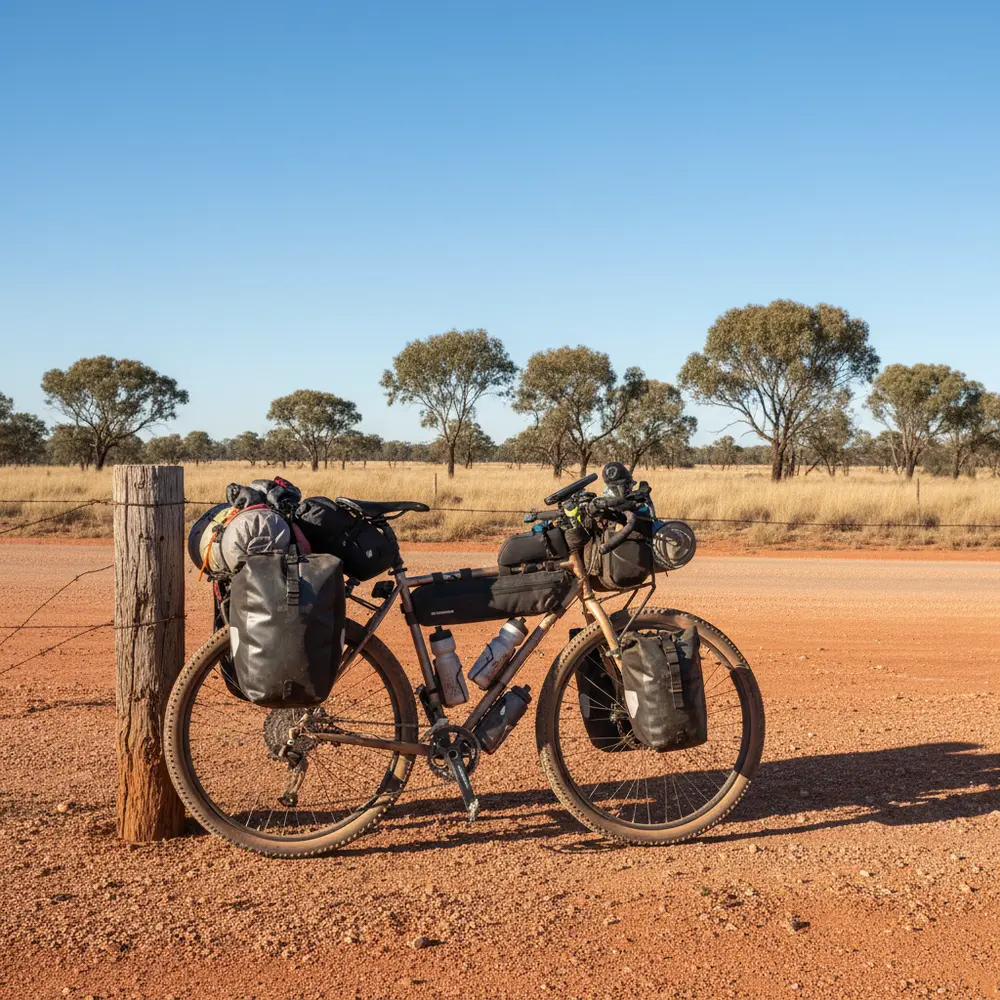
A gravel bike with bikepacking bags is a capable and enjoyable setup for a 3 to 5 day trip with minimal camping gear, or for faster-paced touring where you are staying in accommodation. Once you are self-supported for 7 or more days with a tent, sleeping kit, cooking gear, and food and water for remote sections, a dedicated touring bike with a rack-and-pannier system carries that load more efficiently and more comfortably.
As explored in Bicycling Australia's breakdown of bikepacking vs touring, rack and pannier setups offer greater carrying capacity for longer self-supported trips, while bikepacking bags suit lighter and more off-road focused setups.
- Choose a dedicated touring bike if: you are carrying 15kg or more, your trip is 7 days plus, or you are riding remote routes where reliability matters above all.
- Choose a gravel bike with bikepacking bags if: your load is light, your route is mostly off-road, and you want a more agile and versatile ride.
- A road bike is not suitable for most Australian multi-day touring unless you are exclusively on sealed roads with supported luggage.
Top Touring Bikes Available in Australia (Mid-Range to High-End)
Rather than listing specific models that change with each season, it is more useful to know what to look for at each price point. For detailed current model comparisons and Australian pricing, the touring bike buyer's guide at Bicycles.net.au is worth checking before you walk into a shop.
- Under $1,500: Options exist but expect compromises in component quality. Look for a CrMo steel frame, a wide-range groupset, and confirmed rack mounts. Avoid bikes sold as "touring" that lack proper eyelets.
- $1,500 to $3,000: This is the sweet spot for most Australian tourers. You can find well-specced steel or aluminium bikes with hydraulic disc brakes, solid groupsets, and proper mounting points. Brands like Trek (520 series), Surly, and Koga have strong reputations in this range.
- $3,000 and above: Higher-end steel, titanium, or custom builds. Better components, more refined geometry, and longer service life. Worth it if you tour regularly or are planning a long expedition-style trip.
Whatever your budget, buy from a retailer with good after-sales support. You may need warranty assistance or component sourcing on the road, and a reputable local dealer matters more for a touring bike than for almost any other purchase.
Building Your Touring Setup - Racks, Panniers, and Load Management
The bike is only part of the equation. How you load it has as big an impact on handling and comfort as the frame geometry itself. A poorly loaded bike with 25 kilograms stacked high and to the rear will handle like a pig, regardless of how good the frame is.
The general principle is to keep weight low and centred. Front and rear racks with low-rider front panniers give you the best weight distribution for loaded touring. Aim to split the load roughly 40 percent front and 60 percent rear as a starting point, then adjust based on how the bike handles.
- Invest in quality panniers with reliable waterproofing. Ortlieb is widely trusted. There are good alternatives, but waterproofing matters on Australian tours where afternoon storms can appear quickly.
- Use a handlebar bag or top tube bag for things you need frequently during the day, so you are not digging into panniers at every stop.
- Keep the heaviest items low and close to the centre of the bike. Tent poles strapped high on a rear rack will make the bike feel unstable.
- Check that the rack is rated for the load you are carrying. Most quality racks are rated at 25 to 35 kilograms, but check the specific product spec.
For planning your route and understanding what popular Australian touring events look like at the organised end, Bicycle Network's long-distance touring events page gives you a useful sense of how experienced riders approach multi-day rides in Australia.
Pre-Departure Bike Checklist
Run through this the morning you leave. It takes about 20 minutes and it will save you a lot of grief on day one.
- Frame and fork: Inspect welds, joints, and the fork crown for cracks or damage, especially around rack mount points.
- Brakes: Check pad wear (rim brakes) or rotor and pad condition (disc brakes). Squeeze each lever firmly and confirm the bike stops cleanly.
- Drivetrain: Check chain wear with a chain checker. Run through all gears under light load. Apply fresh chain lube.
- Tyres: Check for cuts, embedded glass, or sidewall wear. Inflate to the correct pressure for your load and surface type.
- Racks and mounts: Check every bolt on your racks and pannier mounts. Apply threadlock to any bolt that keeps loosening.
- Spoke tension: Spin each wheel and check for wobble. Pluck the spokes. They should all sound roughly the same pitch.
- Headset and bottom bracket: Hold the front brake and rock the bike forward. Any clunk indicates headset play. Twist the cranks and check for lateral movement at the bottom bracket.
- Lighting: Turn on front and rear lights. Check battery charge. Carry spare batteries or a USB charging cable.
- Spare tube and patch kit: Two spare tubes minimum. Patch kit, tyre levers, and a pump or CO2 inflator.
- Multi-tool and chain lube: Confirm you have a multi-tool with the hex key sizes your bike actually uses. Carry at least one small bottle of chain lube.
Common Mistakes to Avoid
- Overloading the rear rack: Packing everything at the back kills handling. Balance the load front and rear.
- Buying a bike without proper rack mounts: Not all bikes marketed as "adventure" bikes have dedicated eyelets. Check before you buy.
- Skipping the shakedown ride: Do a loaded 2 to 3 day ride before your main trip. You will find problems early when you can still fix them easily.
- Ignoring tyre clearance: A bike that maxes out at 32mm tyres will not handle Australian mixed surfaces comfortably with a load.
- Underestimating water carry requirements: Remote Australian sections can have very long distances between reliable water. Multiple bottle mounts are not optional.
- Choosing a bike based on aesthetics alone: The geometry, gearing range, and mounting points matter far more than what the bike looks like.
If You Are New to Touring
- Start with a supported or semi-supported tour before attempting a fully self-supported trip.
- Choose a well-travelled route with reliable resupply points for your first multi-day ride.
- Do not buy the most expensive touring bike straight away. A solid mid-range steel bike will serve you very well while you figure out what you actually need.
- Pack light on your first trip. You will almost certainly bring too much. Everything you carry, you pedal.
- Join a local cycling club or online community to find riders who have done Australian touring and can share practical advice. The Segment Club community is a good place to start.
If You Have Toured Before
- Review your existing setup critically. Are you happy with how the bike handles when fully loaded? If not, consider whether it is a loading issue or a geometry issue.
- Consider upgrading to hydraulic disc brakes if you are still running rim brakes and regularly ride loaded descents.
- Experiment with tyre widths. Many experienced tourers go wider than they initially think they need, and find the comfort improvement worth the small increase in rolling resistance.
- Look at your carrying system. If you are running rear-only panniers, adding a front rack and low-rider bags can significantly improve handling on longer trips.
- Plan a more demanding route. Australia has incredible options. The Munda Biddi Trail in WA and the Heysen Trail cycling sections in SA are both worth planning properly if you have not ridden them.
Frequently asked questions
Is a gravel bike good enough for a multi-day Australian tour?
For lighter loads and shorter trips, yes. A gravel bike with bikepacking bags handles 3 to 5 day trips well, particularly on mixed terrain. Once you are carrying full camping gear for a week or more, a dedicated touring bike with rack-and-pannier mounts will carry that load more comfortably and more efficiently.
What is the best frame material for a touring bike in Australia?
Chromoly steel is the most practical choice for most Australian tourers, particularly those riding remote routes. It is repairable in the field, compliant over long days, and durable. Aluminium is a reasonable budget alternative but is harder to repair if damaged. Titanium is excellent but expensive. Carbon is generally not recommended for loaded touring.
Are 26-inch wheels still worth considering for Australian touring?
In remote outback areas, 26-inch tyres can be easier to source than 700c sizes at small rural stores. If your route takes you through very remote sections, this is worth considering. For most Australian touring routes, 700c wheels are fine and offer a wider choice of tyre options.
What should I budget for a quality touring bike in Australia?
A well-specced mid-range touring bike suitable for serious Australian touring typically costs between $1,500 and $3,000. Below $1,500, compromises in component quality become significant. Above $3,000, you are buying better components, refined geometry, and longer service life, which is worthwhile if you tour regularly.
Do I need hydraulic disc brakes on a touring bike?
They are increasingly standard at mid-range price points and are genuinely better for loaded descents. If you are buying new, look for hydraulic disc brakes. If you are working with an existing bike with rim or mechanical disc brakes, they are not a reason to replace the bike immediately. Rim brakes work fine on flat to moderate terrain with a well-maintained setup.
Wrapping Up
Choosing the right touring bike for Australian conditions comes down to being honest about where you are riding, how much you are carrying, and how long you will be out there. Get those three things right and the rest of the decision falls into place.
- Dedicated touring bikes outperform road and gravel bikes once load and distance increase.
- Steel frames, wide-range gearing, disc brakes, and confirmed rack mounts are the non-negotiables.
- Match your tyre width to your route surface. Go wider than you think you need.
- Load the bike properly. Balance matters as much as the bike itself.
- Australia has world-class touring routes. Plan carefully, ride self-sufficiently, and enjoy it.
If you want to talk through your specific setup or route plans, get in touch with the Segment Club team. We are happy to help you work through the decision before you commit.
Want to read more about bike types and choosing the right ride for your goals? Check out our Types of Bikes section for more practical guides.
This is educational content, not financial advice.