Riding on sand is one of those experiences that looks cruisy until you actually try it. The right bike setup makes a serious difference between a genuinely fun beach ride and a grinding slog that leaves you pushing more than pedalling.
By the end of this article you will know how fat bikes and mountain bikes actually compare on Australian beach and sand terrain, what tyre pressure to run on each, and which bike suits your situation best. No fluff, just practical advice you can act on.
Note for Australian riders:
- Beach access rules vary widely across Australian states and local councils. Some popular beaches in NSW, QLD and VIC restrict or ban bikes during peak hours or peak season. Always check with your local council or national park authority before riding an unfamiliar beach. See beach riding access rules across Australian states for community-sourced guidance.
- Fat bikes are less widely available in Australia than in North American or European markets. Stock is growing but expect fewer options and higher prices than overseas.
- Salt and sand together accelerate drivetrain and bearing wear faster than regular dirt riding. Post-ride maintenance is not optional if you want your bike to last.
At a glance:
- Fat bikes dominate on deep, dry, loose sand. The floatation advantage is real.
- On wet, packed beach sand a well-set-up MTB with wide tyres and low pressure can perform adequately.
- Tyre pressure is the single biggest variable for either bike on sand. Get it wrong and neither bike will feel right.
- If you already own an MTB, try optimising it first before buying a fat bike.
Key takeaways:
- The type of sand matters more than the type of bike in many real-world scenarios.
- Fat bikes carry a weight and cost penalty that is worth understanding before you buy.
- Post-ride cleaning after any beach session is non-negotiable regardless of which bike you ride.
What Makes Sand and Beach Riding So Hard on a Bike?
Sand does not behave like dirt, gravel or even mud. It is a loose, shifting surface that deforms under your tyre rather than supporting it. That deformation is where most of your energy goes, which is why riding on sand feels like riding through thick carpet.
The harder you push, the more your tyre sinks in. A narrow tyre at standard pressure cuts down through the surface instead of riding over it. This is the core mechanical problem that fat bikes are designed to address.
How Sand Behaves Differently to Dirt and Gravel
On a firm surface, rolling resistance is mainly about tyre deformation. On sand it flips. The dominant resistance comes from the surface itself deforming around your tyre. As tyre pressure and rolling resistance physics explains, this is why floatation matters so much on soft terrain. A wider, lower-pressure tyre spreads the load across a larger contact patch, which reduces how far the tyre sinks into the surface.
Wet, packed sand near the water line behaves almost like a firm gravel path. Dry, loose sand further up the beach is an entirely different beast. Knowing which type of sand you are mainly riding on is actually the most important question before choosing a bike setup.
Fat Bikes Explained: What They Are and How They Work on Sand
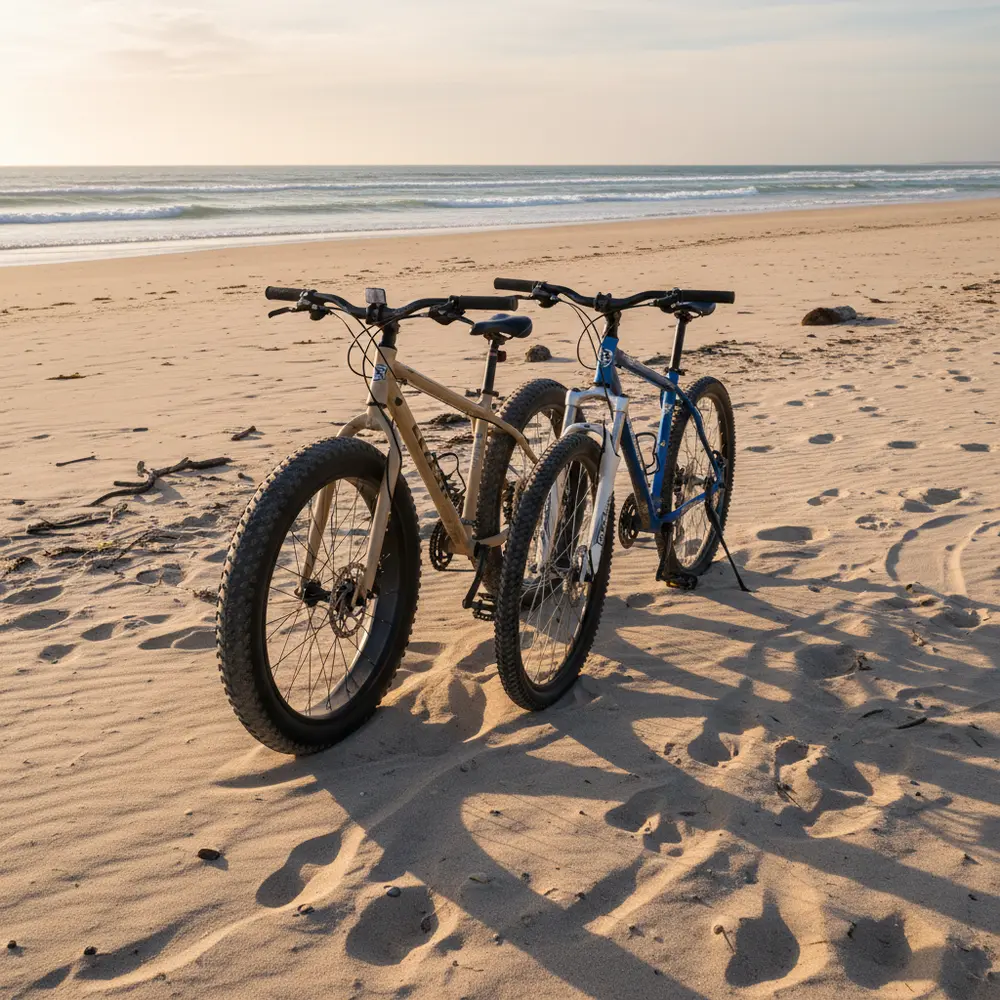
A fat bike is a bicycle built around oversized tyres, typically in the 3.8 to 5 inch width range, running on rims wide enough to support them without collapsing. The frames are purpose-built with wider fork clearances and bottom bracket shells to fit those tyres. For a full rundown on design and specs, fat bikes explained by Bicycles Network Australia is worth reading.
The core advantage is floatation. When you drop tyre pressure to 5-10 psi on a fat bike, the tyre spreads laterally and conforms to the surface rather than digging into it. That contact patch is dramatically larger than anything an MTB tyre can produce, which is why fat bikes genuinely work on soft dry sand where an MTB would struggle.
Tyre Width, Volume and Float: Why It Matters on Soft Surfaces
Tyre volume is the key variable, not just width. A larger volume tyre holds more air, which allows you to run very low pressure without the rim bottoming out on the ground. That combination of high volume and low pressure is what creates floatation on sand.
- Fat bike tyres: 3.8 to 5 inches wide, typically 26-inch wheels, very high air volume
- MTB tyres: 2.3 to 2.6 inches wide on a 29er, lower volume by comparison
- A 29 x 2.6 MTB tyre has more volume than a 26 x 2.4, but still far less than a 4-inch fat bike tyre
- More volume means you can run lower pressure without pinch flatting or rim damage
The physics are straightforward. More contact area on a soft surface means less sinking, less resistance, and an easier ride. That is why fat bikes are not a gimmick on the right terrain. They are a legitimate tool, just a specialised one.
Mountain Bikes on the Beach: Where They Cope and Where They Struggle
An MTB is not useless on the beach. Plenty of Australian riders do perfectly enjoyable coastal rides on hardtail MTBs every weekend. The key is knowing which conditions suit an MTB and setting it up correctly for them.
An MTB with 2.4 inch or wider tyres dropped to around 18-22 psi will handle wet, packed sand near the water reasonably well. It is when you hit the dry, loose sand higher up the beach or on sand track approaches that an MTB starts to feel like hard work. The Australian MTB beach riding guide from Australian Mountain Bike points out that a hardtail with wide, low-pressure tyres is a solid starting point before committing to a fat bike purchase.
Hardtail vs Full-Sus MTB on Sand: Is There a Difference?
On sand, the suspension system is less of a factor than it is on rocky or rooted trail. Sand does not generate sharp impacts, so the extra traction and comfort benefit of full suspension is reduced. A hardtail is actually a practical choice for beach riding because it is lighter, simpler to maintain, and the energy lost to suspension bob on flat sand is not a factor.
- Hardtail: lighter, simpler, sufficient for most beach conditions
- Full-sus: no significant float advantage on sand, more to clean and maintain after salt exposure
- Either way, tyre choice and pressure matter far more than the suspension setup on a beach
Head-to-Head Comparison: Fat Bike vs MTB for Beach and Sand Riding
Here is a straight comparison across the conditions and factors that matter most for Australian beach riders.
| Factor | Fat Bike | MTB (Wide Tyres) |
|---|---|---|
| Deep, dry loose sand | Clear advantage. Floatation makes it manageable. | Struggles. High effort, frequent stalling. |
| Wet, packed beach sand | Works well but advantage narrows. | Performs adequately with low pressure and wide tyres. |
| Hard-packed coastal trails | Slower, more effort due to rolling resistance and weight. | Natural territory. Efficient and comfortable. |
| Mixed terrain bikepacking | Compromise on hard sections. Fat bike guide for adventure riding covers this well. | Better overall for mixed surfaces. |
| Weight | Heavier than comparable MTB. | Lighter, easier to handle off-bike. |
| Cost in Australia | Entry-level from around $1,000-1,500 AUD. Mid-range $2,000-3,500 AUD. | Wide range available. More stock, more choice. |
| Availability in Australia | Limited but growing. Trek, Specialized, Giant have models. | Wide selection across all price points. |
The honest summary from rider-tested comparisons is that fat bikes hold a clear edge on deep dry sand but the performance gap narrows significantly on wet packed surfaces. Pedalling a fat bike on hard ground is noticeably harder due to rolling resistance and weight. That trade-off matters if your ride includes more than just pure sand.
Tyre Pressure Settings for Sand: Fat Bike and MTB Side by Side
Tyre pressure is the single most impactful adjustment you can make on either bike for sand riding. Running too high a pressure on a fat bike largely cancels out the floatation advantage. On an MTB, dropping pressure opens up the tyre contact patch and makes a real difference on packed sand.
- Fat bike on dry, loose sand: 5-8 psi (lighter riders toward the lower end)
- Fat bike on wet, packed sand: 8-12 psi
- MTB (2.4 inch tyre) on packed beach sand: 18-22 psi
- Heavier riders add 1-2 psi to avoid rim strikes on either bike
- Always check for rim strike risk at very low pressures before committing to a full ride
These ranges are drawn from rider-shared experience in the fat bike tyre pressure guide at MTBR and reflect general consensus rather than a single definitive source. Your ideal pressure will shift slightly based on your weight, tyre brand and exact surface. Start conservatively and adjust.
Australian Beach and Sand Riding Conditions: What You Need to Know
Australian beach riding conditions vary a lot by state. WA and QLD offer some of the best sand riding terrain in the country, with wide flat beaches and in some areas access to genuine beach driving tracks that cyclists can use. Victoria's Mornington Peninsula and parts of South Australia also offer solid coastal riding options. For a directory of coastal MTB trails across Australia, it is worth browsing before planning a trip.
Access rules are a real consideration. Some popular beaches in NSW, VIC and QLD ban or restrict bikes during peak hours or summer season. WA and SA tend to be more permissive in remote and regional coastal areas. Always check with the relevant local council or national park authority before riding a beach you have not ridden before.
Salt and sand corrosion: the maintenance reality
- Salt accelerates corrosion on steel components, bearings and cable housings much faster than regular dirt riding
- Rinse your entire bike with fresh water as soon as possible after every beach session
- Use a wet lubricant on your chain after the rinse, not a dry lube which will attract sand particles
- Check and re-grease bearings regularly if you ride the beach more than a few times a year
- Sealed bearing hubs and bottom brackets reduce the maintenance burden significantly for regular coastal riders
- For full guidance, see how to maintain your bike after a beach ride from Bicycling Australia
Which Bike Should You Choose: A Practical Decision Guide
Use this decision tree to work out the right call for your situation. Start at the top and follow the branches that match you.
- How often do you ride on sand versus other terrain? If sand is less than 20-30% of your riding, stick with your MTB and optimise it. If sand is the majority of your riding, a fat bike is worth considering.
- What type of sand will you mainly be riding? Wet, packed beach sand near the water line. A good MTB setup will handle this. Dry, loose sand or sand tracks away from the waterline. A fat bike has a genuine advantage here.
- Do you already own an MTB? Yes. Try fitting the widest tyres your frame allows, drop pressure to 18-22 psi and ride a few beach sessions before deciding whether you need a fat bike. No. If you want one bike that handles mixed terrain including beaches, a 29er hardtail MTB with 2.4+ inch tyres is the more versatile choice unless your primary goal is deep sand riding.
- Are you planning adventure touring or bikepacking on coastal tracks? If the route includes significant sand sections mixed with hard trail, a fat bike involves real compromise on the non-sand sections. An MTB or gravel bike with wide tyres is likely a better touring choice unless the sand is the whole point.
- What is your budget? If you are looking at entry-level options, fat bikes start around $1,000-1,500 AUD in Australia but the range is more limited. A comparable MTB will give you more choice at the same price point. Check fat bikes available in Australia on 99 Spokes to get a current read on models and pricing.
Common Mistakes When Riding on Sand
- Running tyre pressure that is too high. This is the number one issue on both fat bikes and MTBs on sand. Drop the pressure before you ride, not after you get stuck.
- Choosing the wrong part of the beach. Dry loose sand higher up the beach is much harder to ride than wet packed sand near the water. Stick to the firmer strip when you can.
- Not rinsing the bike after a beach session. Salt and sand left on your bike overnight will start to cause damage quickly. A fresh water rinse takes five minutes and saves you real money.
- Buying a fat bike for occasional beach rides. If sand is a small part of your riding, the cost, weight and reduced efficiency on other terrain is hard to justify.
- Using a dry chain lube before a beach ride. Dry lubes attract sand and create a grinding paste in your drivetrain. Use a wet lube and reapply after cleaning post-ride.
If You Are New to Beach or Sand Riding
- Start on wet, packed sand near the water line where an MTB will feel manageable.
- Drop your tyre pressure to around 18-22 psi on a 2.4 inch tyre before you hit the sand.
- Ride in the morning before the beach fills with people and while the sand is still firm.
- Expect it to feel harder than trail riding. Sand riding demands more effort for the same distance. Start short.
- Rinse your bike every single time, no matter how clean it looks. Salt is invisible and destructive.
- Check our Types of Bikes guides if you are still working out what bike suits your riding style overall.
If You Have Ridden on Beach or Sand Before
- Experiment with pressure in smaller increments. Even 2-3 psi can make a noticeable difference on sand.
- Try riding earlier in the morning or after rainfall when sand is firmer and the fat bike advantage shrinks.
- If you already own an MTB and are tempted by a fat bike, hire one before you buy. Some coastal hire shops in WA and QLD stock fat bikes.
- Consider tubeless conversion on your MTB if you have not already. It allows you to run lower pressures with less pinch flat risk on beach terrain.
- For bikepacking coastal tracks, map the terrain before committing to a fat bike. Mixed sand and hard trail often suits a 29er hardtail better.
- Have more questions or want a specific bike recommendation? Get in touch with us and we will point you in the right direction.
Frequently asked questions
Can a standard mountain bike actually ride on the beach?
Yes, with the right setup. A hardtail MTB with 2.4 inch or wider tyres dropped to around 18-22 psi will handle wet, packed beach sand reasonably well. It will struggle on deep, dry, loose sand, but most Australian beach riding involves a mix of both. An MTB is a practical and versatile starting point before committing to a fat bike.
What tyre pressure should I run on a fat bike on sand?
For dry, loose sand the general consensus is 5-8 psi on a fat bike, adjusted upward slightly for heavier riders to avoid rim strikes. On wet, packed sand 8-12 psi works well. Running too high a pressure largely cancels out the floatation advantage of fat tyres, so erring on the lower side is usually the right call.
Are fat bikes worth buying in Australia given the limited availability?
It depends on how much of your riding involves genuine soft sand. If you ride on deep, loose sand regularly, a fat bike is a legitimate tool and worth the investment. If sand is occasional, optimising your existing MTB with wider tyres and low pressure is the more practical choice. Brands including Trek, Specialized and Giant have Australian distribution, so options exist, they are just fewer than overseas.
Do I need permission to ride on Australian beaches?
It varies significantly by location. Some popular beaches in NSW, VIC and QLD restrict or ban cycling during peak hours or peak season. Western Australia and South Australia tend to have more permissive access, especially in remote and regional coastal areas. Always check with the relevant local council or national park authority before riding a beach you have not ridden before.
How do I protect my bike from salt and sand damage?
The most important step is a fresh water rinse immediately after every beach session. Follow that with a wet chain lubricant rather than a dry lube, which attracts sand. Check bearings and cable housings regularly if you ride coastal terrain often. Sealed bearing hubs and bottom brackets reduce the maintenance burden considerably for regular beach riders.
Wrapping Up
The short version:
- Fat bikes genuinely work on deep, dry, loose sand. They are a real tool for specific terrain, not a gimmick.
- On wet, packed beach sand a well-set-up MTB with wide tyres and low pressure can hold its own.
- Tyre pressure is the single biggest variable on either bike. Nail that before worrying about anything else.
- If you already own an MTB, try it on the beach properly set up before spending money on a fat bike.
- Whatever you ride, rinse it with fresh water after every beach session. Salt is your drivetrain's worst enemy.
Explore more in our Types of Bikes section for more bike comparisons and practical guides for Australian riders.
This is educational content, not financial advice.