If you live in an apartment in Sydney, Melbourne, Brisbane or any other Australian city, finding somewhere to put a full-size bike is genuinely difficult. Folding bikes solve a real problem, but they come with real trade-offs too, and knowing both sides before you buy will save you a lot of frustration.
By the end of this article you will know whether a folding bike actually suits your setup, what to look for when shopping in Australia, and how to get the most out of one day to day. We will cover storage, public transport rules, brands available locally and the honest riding experience.
Note for Australia:
- Public transport rules for bikes vary significantly between Sydney, Melbourne, Brisbane, Perth and Adelaide. Always check with your specific operator before assuming your folding bike is permitted.
- Many apartment buildings built before 2010 have little or no dedicated bike storage. Strata bylaws in some buildings also restrict bikes in lifts or common areas, making a fold-and-store-inside approach genuinely useful.
- Folding bikes in Australia often cost more than international listings suggest due to shipping and import costs. Budget accordingly and factor in local warranty support.
At a glance:
- Folding bikes are a practical answer to apartment storage and public transport access in Australian cities.
- Wheel size, hinge quality and weight are the three most important buying decisions.
- Brompton, Tern and Dahon are the main brands with genuine Australian availability.
- Smaller wheels ride differently to a standard bike. It is not better or worse, just different, and worth knowing before you buy.
Key takeaways:
- Always check your city's public transport rules for folding bikes before relying on them for your commute.
- Budget folding bikes under around AUD 500 often have hinge reliability issues over time. Spend a little more if you plan to use it regularly.
- Test-fold any bike in the shop before purchasing. If you cannot do it confidently in under 30 seconds, it will become annoying quickly.
Why Folding Bikes Make Sense for Apartment Living in Australia
The Space Problem Every City Cyclist Knows
A standard road or hybrid bike is roughly 170 to 180cm long and about 100cm tall. In a one-bedroom apartment with no storage cage, that is a serious footprint. Even if your building has a cage, apartment bike storage in Australia is patchy at best. Many buildings built before 2010 simply did not plan for cyclists.
Newer developments in Sydney and Melbourne are increasingly required to include bike storage under planning rules, but older stock is a different story. Strata bylaws in some buildings also prohibit bikes in lifts or shared corridors, which means getting a full-size bike to your front door becomes its own obstacle course. A folding bike stored inside your actual apartment is not subject to those restrictions in most cases.
Bike theft in inner-city areas is a genuine issue too. Keeping your bike inside rather than locked to a cage or street furniture removes that risk entirely.
Taking Your Bike on Public Transport in Australian Cities
This is where a folding bike earns its keep in a way no other bike can match. Full-size bikes are restricted on most Australian train networks during peak hours. Folding bikes, when folded, are generally treated as luggage and permitted at any time on many networks. That said, the rules differ between states and even between operators within the same state.
According to Bicycle Network's guide on bikes on public transport in Australia, folding bikes are often treated more favourably than full-size bikes provided they are folded and, in some cases, covered or bagged. Some networks have no restrictions at all on a folded bike. Others want it covered. Always check with your specific operator.
- Melbourne (Metro Trains): Folded bikes generally permitted as luggage. Full-size bikes have time restrictions.
- Sydney (Sydney Trains): Rules apply to full-size bikes in peak hours. Folded bikes in a bag are treated as luggage in most cases. Check sydney trains rules for your line.
- Brisbane (Translink): Bikes permitted on trains off-peak. Folded bikes have more flexibility. Bus rules vary by route.
- Perth (Transperth): Bikes permitted on trains with some restrictions. Folded bikes treated as luggage.
- Adelaide (Adelaide Metro): Check directly with the operator as rules have changed in recent years.
The bottom line: a folding bike gives you genuine flexibility that a full-size bike cannot match on Australian public transport networks. But do your homework for your specific city and line before you rely on it.
What to Look for When Buying a Folding Bike
There are a few things that matter more than brand name when buying a folding bike. Get these right and almost any reputable brand will serve you well.
Wheel Size and How It Affects Your Ride
Most folding bikes come in 16-inch or 20-inch wheel sizes. A small number use other sizes, but these two dominate the market. Wheel size is not just about how small the bike folds. It directly affects how the bike rides, and this surprises a lot of people coming from a standard bike.
- 16-inch wheels: Fold smaller and lighter. More responsive steering. Feel livelier at lower speeds. Best for shorter commutes and heavy public transport use. The Brompton uses a 16-inch wheel.
- 20-inch wheels: Closer to a standard bike feel. More stable at speed. Handle bumps and rougher surfaces better. Most Tern and Dahon models use 20-inch wheels. Better for commutes over 5km.
If your main priority is the smallest possible fold for tight spaces and frequent train use, 16-inch is worth considering. If you plan to ride 10km or more each way and want something that feels closer to a normal bike, 20-inch is the better call for most riders.
One note for Melbourne riders: tram tracks are a documented hazard for narrow-tyred and small-wheeled bikes. Take them at a 90-degree angle and slow down. This applies to any folding bike but is worth keeping front of mind when cycling in Melbourne's CBD.
Fold Mechanism Types and What They Mean Day to Day
Most folding bikes use one of two main fold approaches. Understanding them helps you choose based on how you will actually use the bike, not just how it looks in a review.
| Fold Type | How It Works | Best For | Example Brands |
|---|---|---|---|
| Mid-fold (single hinge) | Frame folds in the middle. Handlebar and pedals also fold. | Riders who want a simpler mechanism and a larger folded size is acceptable. | Dahon, Tern |
| Three-fold | Three separate fold points create a very compact package. | Riders who need the smallest possible folded size for tight spaces or frequent travel. | Brompton |
The mid-fold is simpler to learn and generally more robust over time. The three-fold, as used by Brompton, produces a noticeably smaller folded package which is genuinely useful if you are storing under a desk or in a small apartment hallway. The trade-off is a slightly more involved fold sequence that takes a few sessions to get fast at.
Weight, Carry Handles and Real-World Portability
A folding bike you cannot comfortably carry is only half the solution. Most folding bikes weigh somewhere between 9kg and 14kg depending on the frame material and spec. Steel frames are heavier but more durable and often cheaper to repair. Aluminium frames save weight but can cost more at a given spec level.
Check that the folded bike has a carry handle or a rolling wheel in the folded position before you buy. Carrying 12kg up three flights of stairs without a proper handle gets old very fast. Check the CHOICE folding bike buying guide for an honest breakdown of weight and portability considerations for Australian buyers.
Popular Folding Bike Brands Available in Australia
There are more folding bike brands available online than there are through local dealers in Australia. Sticking to brands with genuine local distribution means you have someone to talk to if something goes wrong, and you are covered more clearly under Australian Consumer Law.
- Brompton: The premium option. Very compact fold. Higher price point. Strong resale value. Brompton Australia sells direct and through selected dealers. Electric models available.
- Tern: Strong mid-range option with 20-inch wheels and good accessory compatibility. Tern Bicycles Australia has a dealer network worth checking. The Link and Verge series are popular with commuters.
- Dahon: The most accessible price point with a wide range of models. Dahon folding bikes in Australia are available through select retailers and online. Good entry point but check hinge quality on lower-priced models.
- Polygon: An Indonesian brand with growing Australian availability. Decent value for money at the mid-range level.
If you are buying a grey-import or ordering from overseas, be aware that warranty claims can be complicated. Parts availability in Australia for lesser-known brands can also be an issue, especially for proprietary components.
Electric folding bikes are also worth a mention. They are a growing category and genuinely useful in hillier areas like some Brisbane suburbs or Sydney's inner west. They cost more and weigh more, but if gradient is stopping you from riding, a small electric assist changes the equation. Check with your local dealer about models with Australian compliance certification before buying.
Folding Bike Riding Experience vs a Standard Bike
Let's be straight about this. A folding bike does not ride like a standard road or hybrid bike, and expecting it to will lead to disappointment. That said, once you adjust your expectations and your riding style, most people adapt quickly.
The main differences a seasoned rider will notice:
- Smaller wheels accelerate faster but lose speed more quickly. You pedal more frequently on a flat.
- Steering is quicker and more sensitive. Descending steep hills requires more focus.
- Ride comfort on rough surfaces depends heavily on tyre width and pressure. Wider tyres at lower pressure absorb more.
- Gear range matters more than on a standard commuter if your route includes any real gradient. More gears or lower gear ratios are worth paying for if you ride hills.
- Sydney's hilly inner suburbs, for example, make gear range a key consideration. Bicycle NSW's cycling in Sydney resources give a good sense of the terrain challenges facing urban commuters in the city.
For flat to gently undulating urban commutes under 15km each way, a quality folding bike is a genuinely capable machine. For long-distance riding or fast group rides, it is not the right tool. Know the job you need it to do.
Storing and Maintaining Your Folding Bike in a Small Space
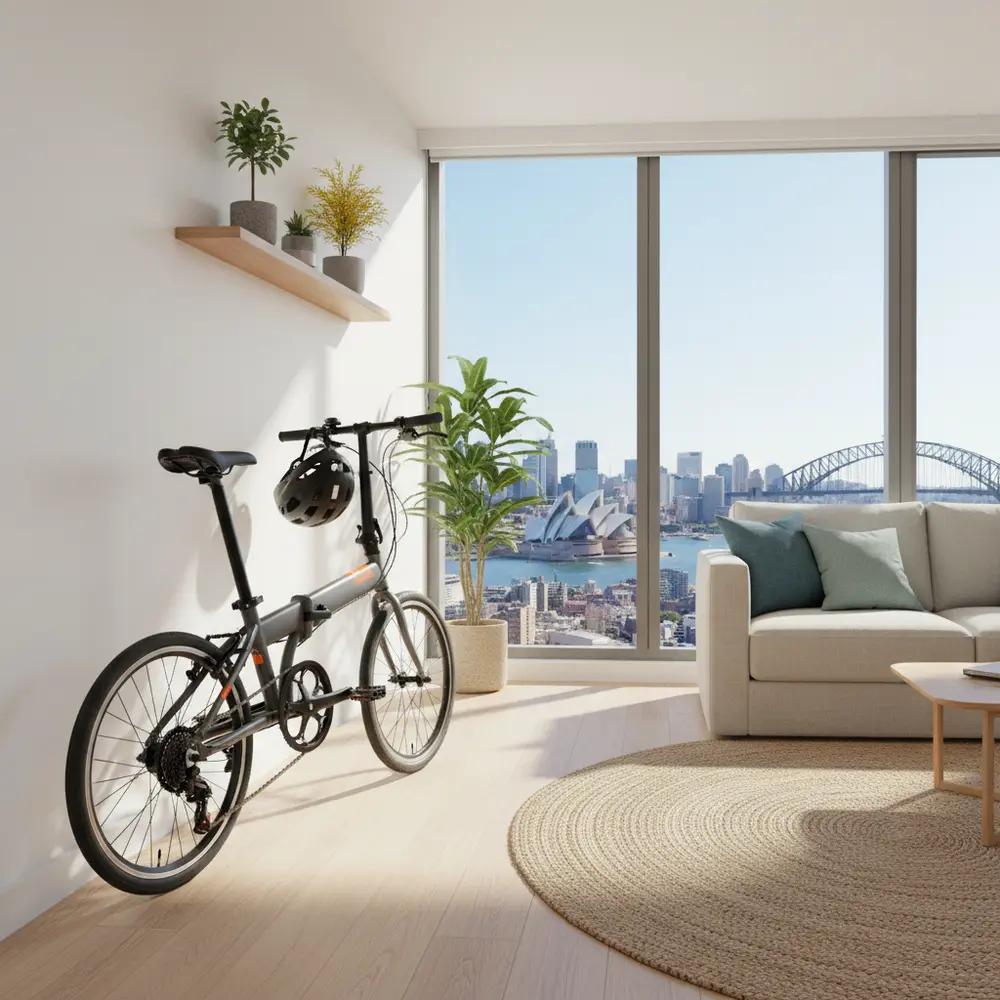
Storage is where the folding bike wins convincingly. A folded Brompton fits in a space roughly the size of a large carry-on bag. Most 20-inch folding bikes fold to something closer to a medium suitcase. Either way, they slide under a bed, behind a couch, or into a hallway cupboard in a way a full-size bike simply cannot.
For maintenance in a small space, the good news is that most of the regular tasks are no different to any other bike. Lubing the chain, checking tyre pressure and adjusting brakes all happen the same way. The additional thing to stay on top of with a folding bike is the hinge. Keep hinge bolts checked and torqued to the manufacturer spec. A loose hinge on a folding bike is not just an annoyance, it is a safety issue.
- Check and lube the hinge every few months if you are folding and unfolding daily.
- Inspect the hinge clamp mechanism for wear, particularly the latch or lever. Replace if it feels loose.
- Check quick-release points on handlebars and seatpost regularly.
- Keep the chain clean and lubed. Smaller chainrings and sprockets on folding bikes can wear faster if neglected.
- Tyre and tube availability: check before you buy that your wheel size is stocked locally. 16-inch tyres are less common in standard bike shops than 20-inch.
If your building does have a storage cage, you can still fold the bike and lock it inside. A folded bike is also harder to strip for parts than one left assembled and locked outside, which is a minor but real advantage in high-theft areas.
Is a Folding Bike Right for You? Key Trade-Offs to Know
A folding bike is not the right answer for everyone. Here is an honest summary of the main trade-offs so you can make the call yourself.
Common mistakes
- Buying on price alone and ending up with a hinge that fails after six months of daily folding.
- Not test-folding in the shop. If the fold takes more than a minute when you are learning it, it will feel like a chore every single day.
- Assuming public transport rules are the same across all cities and operators. They are not.
- Ignoring tyre availability for the wheel size. 16-inch tubes are not on the shelf in every bike shop.
- Underestimating weight when choosing a bike for a multi-flight carry situation.
- Buying a grey-import model with no local warranty support and finding parts are unavailable if something breaks.
If you are new to folding bikes
- Start with a 20-inch wheel model. The ride feel is closer to what you already know and the fold is simpler to learn.
- Budget at least AUD 700 to AUD 800 for a bike you will use daily without hinge headaches.
- Visit a local bike shop that stocks folding bikes and ask to fold and unfold the bike yourself before deciding.
- Check the Australian folding bike buyer guide at Bicycles.net.au for model comparisons in AUD.
- Confirm your building's strata rules before assuming you can wheel a bike through the lobby every day.
If you have ridden folding bikes before
- Consider moving up to a higher-spec hinge and frame. The difference in fold quality and ride feel between budget and mid-range is significant.
- Look at Tern's Verge series or Brompton's P Line if you want a noticeably lighter ride.
- Explore accessory compatibility. Racks, mudguards and lighting mounts are available for most quality folding bikes and make a real difference to daily usability.
- If your commute is hilly, look at the gear range specifically. More gears or a wider range cassette is worth the extra spend.
- Consider an electric folding bike if gradient has been your main frustration. The category has matured and Australian-compliant models are available through reputable dealers.
Before you buy: a practical checklist
- Measure your storage space and check the folded dimensions of the model you are considering.
- Weigh up carry distance. How far will you carry it? Check the weight and test the carry handle.
- Match wheel size to your commute. 16-inch for short hops and heavy PT use. 20-inch for longer daily rides.
- Check gear range against your route gradient. More gears matter more on hills.
- Inspect the hinge quality in the shop. It should feel solid with no play when locked.
- Check local tyre and tube availability for your wheel size before committing.
- Confirm public transport rules for your specific city, line and operator.
- Set a realistic budget. Under AUD 500 is risky for daily use. AUD 700 to AUD 1,500 is the sweet spot for most commuters.
- Test-fold the bike yourself in the shop before buying.
- Check accessory availability for your model. Racks, mudguards and lights should be bolt-on options if you commute year round.
Frequently asked questions
Are folding bikes allowed on trains in Australia during peak hour?
In most cases, yes, but the rules vary by city and operator. When folded, most networks treat a folding bike as luggage, which means peak hour restrictions that apply to full-size bikes do not always apply. Check with your specific operator before relying on this for your commute, as rules can change and some networks do require the bike to be bagged or covered.
Are folding bikes genuinely good for daily commuting or are they a compromise?
For urban commutes under 15km each way on flat to moderate terrain, a quality folding bike is a legitimate daily commuter. The trade-offs in ride feel compared to a standard bike are real but manageable. Most riders adapt within a few weeks. The gains in storage flexibility and public transport access are significant for apartment dwellers.
How much should I spend on a folding bike in Australia?
For reliable daily use, budget at least AUD 700 to AUD 800. Below AUD 500, hinge quality and component durability become genuine concerns if you fold and unfold every day. Premium options from Brompton start higher and are worth it if you need the smallest fold and plan to keep the bike for many years.
Can folding bikes handle Melbourne tram tracks safely?
They can, but smaller wheels require more care. The key is to cross tram tracks at as close to a 90-degree angle as possible and at a controlled speed. Do not try to ride parallel to or at a shallow angle across tracks. This is good practice on any bike, but it matters more with smaller wheels.
Do folding bikes hold their value well in Australia?
Quality folding bikes, particularly Brompton, tend to hold resale value better than standard commuter bikes in the Australian second-hand market. This is partly because supply from authorised dealers is limited and demand is steady. Budget brands hold value less well. If you buy quality and maintain it, you will recoup a reasonable amount if you decide to sell.
Wrapping up
- A folding bike is a practical, well-suited solution for apartment living in Australian cities, but only if you buy the right one for your actual commute and storage situation.
- Wheel size, hinge quality and weight are the three decisions that matter most. Get those right and the brand is secondary.
- Public transport rules across Australian cities are genuinely different. Check your specific network before assuming a folding bike will get you through peak hour unrestricted.
- Budget at least AUD 700 to AUD 800 for daily use. Test-fold in the shop. Check tyre availability locally.
- If you have more questions about choosing a bike for your commute, get in touch with us at Segment Club and we are happy to help point you in the right direction.
This is educational content, not financial advice.