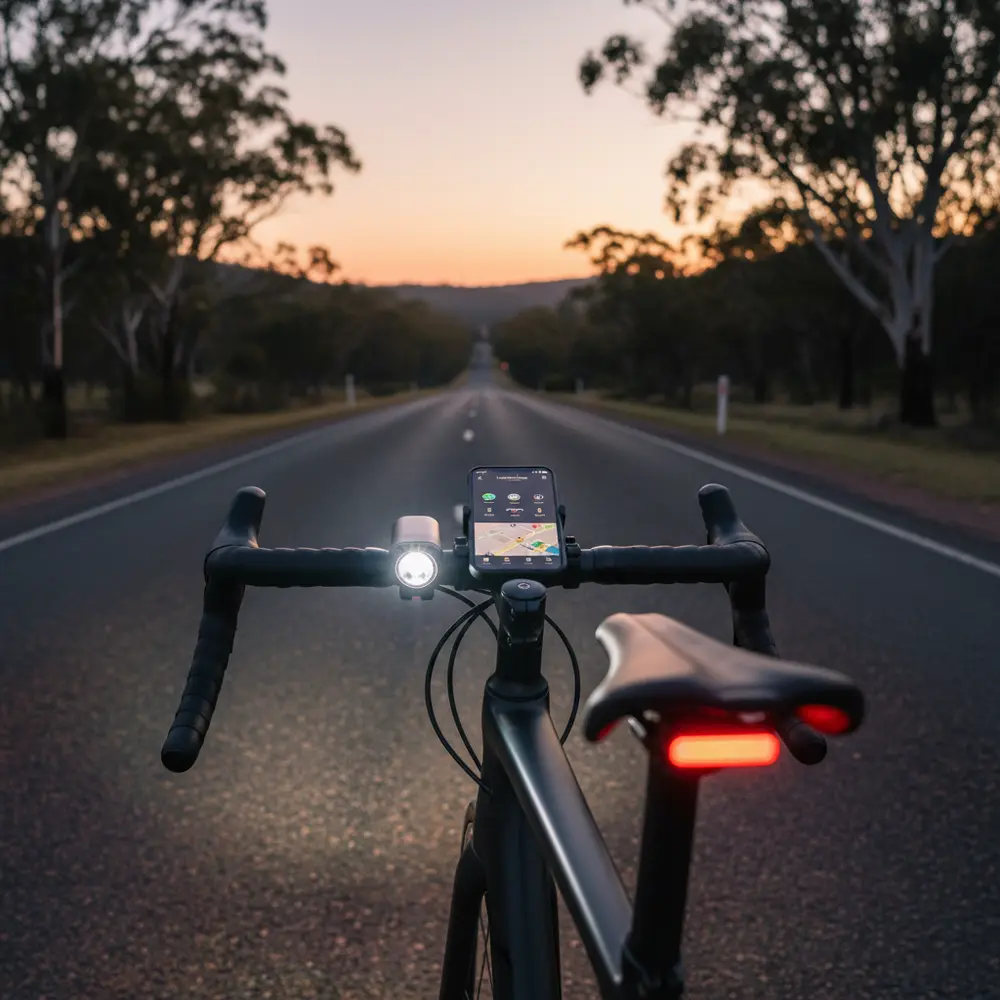
Bike lights have come a long way from the basic blinky you zip-tied to your seatpost. Smart lighting kits that connect to your phone now offer automatic brightness adjustment, brake detection, radar alerts, and full control from an app, and they are genuinely changing how safe it feels to ride in traffic.
By the end of this article you will know how phone-synced lights work, what features actually matter, which kits are worth considering in the Australian market, and what the road rules require of you. You will also have a practical pre-ride checklist to run through before every ride.
Note for Australia:
- Australian road rules are based on the Australian Road Rules framework, but each state and territory adopts and enforces them separately, so always check your local transport authority for the precise wording.
- In NSW and Victoria, cyclists must display a white front light and a red rear light or reflector visible from at least 200 metres when riding at night or in low-visibility conditions.
- Flashing light modes are generally accepted across Australian states, but check your state rules before relying on flashing-only mode as your sole light source.
At a glance:
- Smart bike lights connect to your phone via Bluetooth or ANT+ and let you control modes, check battery, and in some cases get vehicle radar alerts.
- Key features to prioritise are auto-brightness, battery life, mounting security, and whether the light meets your state road rules.
- The Garmin Varia RTL515, Lezyne smart range, and Cycliq Fly series are the most commonly used smart lighting options among Australian cyclists right now.
- Smart lights cost more than basic lights, but for regular commuters and early morning bunch riders the safety benefit is real and measurable.
Key takeaways:
- Phone connectivity adds genuine convenience, but the light still has to meet the legal visibility requirement regardless of how clever the app is.
- Auto-brightness is useful but does not guarantee you are always above the legal minimum, so understand your light's floor setting before relying on it.
- ANT+ and Bluetooth both work well. ANT+ pairs better with cycling computers, Bluetooth pairs directly to your phone.
What Are Smart Lighting Kits and How Do They Differ From Standard Bike Lights
A standard bike light does one thing: it emits light when you switch it on. A smart lighting kit adds a communication layer. The light pairs with your phone, a cycling computer, or both, and that connection unlocks features you simply cannot get from a dumb light.
The practical differences matter most in daily use. Smart lights can dim or brighten automatically based on ambient light sensors. Some rear lights detect braking through an accelerometer and pulse more intensely when you slow down. The Garmin Varia RTL515 goes further and adds a radar unit that detects vehicles approaching from behind, alerting you via your phone or a paired head unit.
For commuters, the auto-brightness feature alone can justify the cost. Riding through a tunnel and back into bright sunlight, the light adjusts without you touching a button. For group ride safety, a radar tail light gives the whole bunch earlier awareness of approaching traffic.
Bluetooth vs ANT+ vs App-Controlled: What the Connectivity Options Actually Mean
Most smart lights now use one or both of two wireless protocols. Understanding the difference saves you frustration at setup time.
| Protocol | Best For | Limitation |
|---|---|---|
| Bluetooth LE | Pairing directly to your smartphone app | Can be slower to reconnect after a dropped signal |
| ANT+ | Pairing to a Garmin Edge or other cycling computer | Requires a compatible head unit, not native on most phones |
| Dual (BT + ANT+) | Works with both your phone and your head unit simultaneously | Usually costs more |
The Garmin Varia RTL515 supports both ANT+ and Bluetooth, which is why it works so well for riders who already use a Garmin Edge. The Garmin Varia RTL515 real-world review on Bike Rumor confirms it pairs via Bluetooth to a smartphone without needing a Garmin head unit at all, which is worth knowing if you ride with just your phone.
Lezyne uses Bluetooth via the Lezyne Ally V2 app, which works well for smartphone control of light modes and battery monitoring. It does not have the same deep integration with third-party computers that ANT+ provides, but for most riders the app control is more than enough.
Key Features to Look For in a Phone-Synced Bike Light Kit
Not every smart feature is worth paying for. Here is what genuinely makes a difference on Australian roads and trails.
- Auto-brightness: Uses an ambient light sensor to adjust output. Useful for commuting through varied light conditions.
- Brake detection: An accelerometer detects deceleration and increases rear light intensity. Adds a layer of visibility in traffic.
- Radar detection: Found on the Garmin Varia range. Detects approaching vehicles and alerts you. Particularly valuable on open roads with fast traffic.
- Battery monitoring in the app: You can check battery level before you leave, not just when the light starts blinking at you mid-ride.
- Programmable modes: Set your preferred day and night modes via the app and the light remembers them.
- Mount quality: A smart light that bounces off the bike on a rough road is useless. Check the mount system before buying.
Auto-Brightness, Daylight Sensors and Brake Detection Explained
Auto-brightness works by reading ambient light levels and adjusting lumen output accordingly. In bright conditions the light pushes more output to remain visible. In low light it can dim to extend battery life. This is a genuine convenience but it comes with a caveat: if your light dims below the legally required visibility threshold, you may not be compliant even though the light is on.
Check the minimum output floor in your light's specs and compare it against your state's visibility requirements. For NSW and Victoria, the standard is a light visible from 200 metres. Most quality smart lights comfortably exceed this even at minimum output, but it is worth confirming for your specific model.
Brake detection is a different sensor again. It reads changes in acceleration and triggers a faster or brighter flash on the rear light when it senses you slowing down. It is not legally recognised as a substitute for hand signals in any Australian state, but it does add a real layer of passive safety in traffic. Think of it as an extra signal, not a replacement for good riding habits.
Top Smart Bike Lighting Kits Available in Australia
The Australian market is reasonably well stocked with smart lighting options. Prices change regularly so check current AUD pricing through local retailers before buying.
Front and Rear Combo Kits Worth Considering
Rather than buying a front and rear separately, a matched kit often gives you consistent app control and a unified battery monitoring experience. Here are the options most commonly found on Australian roads.
- Garmin Varia RTL515 (rear) + Garmin Varia UT800 (front): The headline smart lighting combo for road cyclists. Radar detection on the rear, auto-brightness on both, deep integration with Garmin Edge computers. Check the Garmin Australia cycling safety page for current availability and specs.
- Lezyne Mega Drive (front) + Strip Drive (rear): A solid mid-range option with app control via Lezyne Ally V2. High lumen output on the front, compact rear unit. Widely available through Australian bike shops.
- Cycliq Fly12 (front) + Fly6 (rear): An Australian brand success story. Both units combine a high-quality camera with a functional light. Designed for riders who want evidence recording alongside visibility. Check the Cycliq guide on how to choose the right bike light for detailed product guidance.
- Bontrager Ion Pro RT (front) + Flare RT (rear): Popular with Trek riders. App-controlled via the Bontrager app with solid battery life. Paired well for matched aesthetics and unified control.
You can browse current stock and AUD pricing for most of these through smart bike lights available in Australia at 99 Bikes or through cycling lights online at Pushys. Both are solid local retailers and stock is generally reliable.
Australian Road Rules and Lighting Requirements You Need to Know
This is the section most global articles skip, and it matters. Australian road rules are broadly consistent across states because they draw from a national framework, but each jurisdiction has its own enforcement approach and minor variations.
The core requirement in NSW and Victoria is the same: a white front light and a red rear light, both visible from at least 200 metres, when riding at night or in conditions of low visibility. The NSW cycling road rules on Transport for NSW and the VicRoads cycling and the law page both cover this clearly. Flashing modes are accepted in both states.
A few things smart light users often ask about:
- Brake-light detection is not a legal substitute for hand signals in any Australian state. Use it as an additional visibility feature, not a replacement.
- Smart lights with auto-brightness must still meet the minimum visibility requirement at all times. A light that dims below the legal threshold because of sensor logic is not compliant.
- The Garmin Varia RTL515 functions as a standard rear light when its flashing mode is active, and it meets the rear light requirement in the same way any compliant rear light would. Always confirm with your state's rules if you are unsure.
- For other states and territories, check your relevant transport authority directly. Bicycle Network Australia has a useful cycling at night safety guide that references multi-state requirements.
How to Set Up and Pair Your Smart Bike Lights With Your Phone
Setup is straightforward on most modern smart lights, but there are a few common friction points worth knowing about before you end up standing in the garage frustrated five minutes before a ride.
- Download the relevant app before you try to pair anything. Garmin Connect, Lezyne Ally, or the brand-specific app, whichever applies to your light.
- Make sure the light firmware is up to date. Most apps prompt you to update on first connection, but it is worth checking before a ride rather than during one.
- Enable Bluetooth on your phone and keep the light within close range during pairing. Some lights need to be in pairing mode, which usually means holding the button for a few seconds.
- Once paired, configure your preferred light modes via the app. Set your day mode and night mode, then the light will remember them even when the phone is not connected.
- Test the connection with your phone in your jersey pocket to confirm it stays stable. If you use a handlebar mount for your phone, you will generally get a more reliable signal, but most Bluetooth smart lights maintain a solid connection from a rear jersey pocket without issue.
Battery Life, Charging and Real-World Performance in Australian Conditions
Manufacturer battery claims are made under controlled conditions. Australian conditions add variables: summer heat, dust on charging ports, and the fact that many of us run lights in full-power daytime flashing mode for visibility rather than just at night.
A few honest observations:
- Running a smart light at full brightness in hot conditions reduces battery life compared to the rated spec. Heat affects lithium cells and if your light sits in direct sun before a ride, expect shorter run times.
- The Garmin Varia RTL515 is rated at around 16 hours in flashing mode. With radar active, that figure drops. Plan accordingly on longer rides.
- Most smart lights charge via USB-C now, which makes café stop top-ups easy. Check your light uses USB-C before assuming this.
- Keep charging ports clear of dust and moisture. After wet road rides, dry the port before charging.
Are Smart Lighting Kits Worth the Extra Cost Over Standard Lights
Honest answer: it depends on how you ride. For the daily commuter who rides in mixed light conditions, auto-brightness and battery monitoring in the app are genuinely useful every single day. The premium is easy to justify. For the weekend warrior who rides mostly in daylight and only occasionally at dusk, a quality standard light with a good mount and solid battery life may serve just as well.
Where smart kits earn their price most clearly:
- Solo road riding on open roads with fast traffic, where the Garmin Varia radar genuinely adds awareness you cannot get any other way.
- Commuting in varied light conditions, where auto-brightness removes the need to fiddle with buttons.
- Riders who want evidence recording as well as lighting, where the Cycliq Fly6 and Fly12 serve a dual purpose that no standard light can match.
If budget is tight, a quality non-smart light from a reputable brand will still keep you legal and visible. Smart is better, but basic done right still works.
Common Mistakes to Avoid With Smart Bike Lights
- Not updating firmware before a ride. App updates sometimes change light behaviour and connectivity. Check before you head out.
- Assuming auto-brightness always keeps you legal. Know the minimum output of your light and what your state requires.
- Forgetting to check battery level the night before. Smart lights let you do this in the app. Use that feature.
- Pairing issues from having too many Bluetooth devices active. If your light will not connect, toggle Bluetooth off and on and try again before assuming the light is faulty.
- Loose mounts. A smart light bouncing around or falling off mid-ride is both dangerous and expensive. Check the mount before every ride.
- Not setting the right mode for conditions. Flashing mode for daytime visibility, steady beam or specific night modes after dark, and check your state rules if you are unsure which is required.
If You Are New to Smart Bike Lights
- Start with a single smart rear light before committing to a full kit. The Garmin Varia RTL515 or a Lezyne Strip Drive are good entry points.
- Download the app and do a test pairing at home well before your first ride. Do not try to pair for the first time in the dark at the start of a ride.
- Check your state road rules before buying. Confirm your chosen light meets the minimum visibility requirement.
- Ask at your local bike shop. Staff at most shops ride and can give honest advice about what works in your local riding environment.
- You can browse and compare options through retailers like 99 Bikes to get a sense of what is available and at what price point before visiting a shop.
If You Have Used Standard Bike Lights Before
- The setup process is slightly more involved than a standard light. Allow 15 minutes for first-time pairing and firmware updates.
- Your existing mounts may not be compatible with smart light units. Check the mounting system before ordering online.
- If you already run a Garmin Edge computer, the Varia ecosystem will integrate more cleanly than any other option on the market.
- Smart lights often have more complex mode structures than standard lights. Spend a few minutes in the app understanding what each mode does before you rely on it in traffic.
- Battery management becomes more important. Check battery before every ride, not just when the light is visibly fading.
Pre-Ride Smart Lighting Checklist
Run through this in the five minutes before you roll out. It takes less time than it reads.
- Open the app and confirm front and rear lights are connected and battery levels are acceptable for the planned ride distance.
- Confirm auto-brightness mode is enabled if you want it, or manually select the appropriate mode for your conditions.
- Set flashing mode on the rear light for daytime riding if required by your state rules.
- Check the rear brake-light sensor is responding by giving the bike a quick deceleration push and watching the rear light.
- Physically check both light mounts are secure and the lights are correctly aimed.
- Confirm your state road rules compliance, front white light and rear red light visible from at least 200 metres if riding at night.
- Check the app is updated and no pending firmware updates are waiting that might cause a connectivity issue mid-ride.
Frequently asked questions
Do all Australian states have the same bike lighting rules?
Australian road rules are drawn from a national framework, so the core requirements, white front light and red rear light visible from 200 metres, are broadly consistent. However each state and territory adopts and enforces rules independently, so check your local transport authority for precise requirements in your jurisdiction.
Can I use the Garmin Varia RTL515 without a Garmin Edge head unit?
Yes. The RTL515 pairs via Bluetooth directly to a smartphone and the Garmin Connect app. The experience is improved with a compatible Garmin Edge head unit, which gives you the full radar display, but it is not required for basic light and radar functionality.
Does auto-brightness on smart lights always keep me legally compliant?
Not necessarily. Auto-brightness can dim your light below the legal visibility threshold in some conditions if the ambient sensor reads the environment incorrectly. Check the minimum output floor for your specific light and compare it against your state's visibility requirements.
Are Cycliq Fly6 and Fly12 compliant as both a camera and a light in Australia?
The Cycliq devices function as both integrated lights and cameras. Whether they satisfy the lighting requirement depends on whether the light component meets your state's visibility standards. Check Cycliq's current product specifications and confirm against your state road rules. Cycliq is an Australian-designed brand and their products are built with local compliance in mind, but confirming with your state authority is always the right step.
Is ANT+ being replaced by Bluetooth in smart bike lights?
Newer smart lighting products increasingly lead with Bluetooth LE because it pairs directly to smartphones. ANT+ remains valuable for cyclists using compatible cycling computers, particularly Garmin Edge devices. Many premium smart lights still offer both protocols, so the choice depends on what devices you already use.
Wrapping up
- Smart bike lights that sync with your phone offer real safety benefits including auto-brightness, brake detection, and in some cases radar alerts for approaching vehicles.
- The Garmin Varia, Lezyne smart range, and Cycliq Fly series are the most proven options available to Australian cyclists right now.
- Australian road rules broadly require a white front light and red rear light visible from 200 metres at night. Check your state authority for precise local requirements.
- Auto-brightness is convenient but understand your light's minimum output floor and confirm it meets your state's legal visibility standard.
- Smart kits are worth the cost for regular commuters and open-road solo riders. For casual weekend riders in daylight, a quality standard light still gets the job done.
Have questions about smart cycling accessories or gear choices for Australian conditions? Get in touch with the Segment Club team and we are happy to help point you in the right direction.
Want to keep reading? Check out our guides on cycling accessories and modifications and our cycling safety tips for Australian riders for more practical content.
This is educational content, not financial advice.