Most Australian cyclists know they need lights at night, but far fewer are across what the law actually requires for reflectors, hi-vis clothing, and exactly when those rules kick in. Getting this wrong is not just a fine risk, it is a genuine safety gap that is easy to close once you know what you are dealing with.
By the end of this article you will know the legal requirements for cycling visibility in Australia, the practical difference between hi-vis and reflective gear, and how to put together a setup that works for your riding conditions. Whether you are a daily commuter or a weekend dawn-patrol rider, this is worth a few minutes of your time.
Note for Australia:
- Cycling road rules in Australia are set at state and territory level. The Australian Road Rules provide the national model framework, but each jurisdiction enacts its own version.
- Most states align closely with the national model, but wording and specific requirements can vary. Always check your state or territory road authority for the current rules.
- No Australian state currently requires cyclists to wear hi-vis clothing by law. It is recommended, not mandated.
At a glance:
- A white or yellow front light and a red rear light are legally required at night and in hazardous conditions in all major Australian states.
- A red rear reflector is also a legal requirement across NSW, Victoria, and Queensland.
- Hi-vis clothing is strongly recommended but not a legal obligation for cyclists in any Australian state.
- Retroreflective gear and hi-vis clothing serve different purposes and work best used together.
Key takeaways:
- Meeting the legal minimum is a starting point, not a complete visibility strategy.
- Motion-based visibility aids like ankle bands and wheel reflectors are among the most effective tools you can add.
- Cheap bright-coloured clothing is not the same as certified hi-vis and offers little benefit at night without retroreflective material.
Why Visibility Matters More Than You Might Think on Australian Roads
Cycling in low-light conditions is one of the higher-risk situations a rider can be in, and it is not just about night riding. Pre-dawn commutes, afternoon rides that run long into dusk, overcast winter days, and morning fog all reduce how well drivers can see you. The NSW Centre for Road Safety crash statistics allow you to filter cyclist incidents by lighting condition, and the data consistently shows that low-light and night conditions represent a disproportionate share of serious cyclist crashes relative to the amount of riding done in those conditions.
The good news is that visibility is one of the most affordable and straightforward safety upgrades you can make. You do not need to spend a lot to make a meaningful difference, but you do need to understand what you are buying and why it works.
What Australian Law Actually Requires for Cycling Visibility
The Australian Road Rules set out the national model framework for bicycle lighting. Rule 259 is the key provision. It requires cyclists riding at night or in hazardous weather conditions to use a white or yellow front light and a red rear light, both visible from a reasonable distance. A red rear reflector is also required as part of the bicycle's equipment.
Each state and territory enacts its own version of these rules, so the specific wording and any additional requirements can differ. However, the core obligations are broadly consistent across the country. The Australian Government Department of Infrastructure notes that enforcement of road rules is a state and territory responsibility, so it is worth checking your local authority's current version of the rules.
Fines for riding without required lights or reflectors apply in all major jurisdictions. Clip-on and aftermarket lights are generally accepted as legally equivalent to built-in systems for the purposes of meeting these requirements, provided they are functional and meet the visible-from-distance standard.
State-by-State Breakdown of Reflector and Light Requirements
The table below summarises the core requirements for NSW, Victoria, and Queensland. These are the three most populous states and cover the majority of Australian cyclists. If you ride in another territory, check your state road authority directly.
| State | Front Light | Rear Light | Rear Reflector | Hazardous Conditions |
|---|---|---|---|---|
| NSW | White, visible from a reasonable distance | Red, visible from a reasonable distance | Red, required by law | Lights required in hazardous weather |
| Victoria | White, visible from 200 metres | Red, visible from 200 metres | Red, mandatory | Lights required in hazardous weather |
| Queensland | White or yellow, required at night | Red, required at night | Red, required by law | Recommended in poor conditions |
For NSW, Transport for NSW confirms that both a front white light and a red rear light are required at night and in hazardous conditions, alongside a red rear reflector. For Victoria, VicRoads specifies that lights must be visible from 200 metres and both steady and flashing modes are permitted. For Queensland, the Queensland Department of Transport and Main Roads aligns closely with the national model.
When Are You Legally Required to Use Lights and Reflectors
The legal trigger is riding at night or in hazardous weather conditions. "Night" in the road rules context generally means from 30 minutes after sunset to 30 minutes before sunrise, though exact definitions can vary by jurisdiction. Hazardous conditions typically include heavy rain, fog, smoke, or dust that reduces visibility on the road.
Daytime riding in normal conditions does not legally require lights in most states, though using a rear flashing light during the day is one of the most effective and low-effort visibility upgrades you can make. Many regular riders run a rear light during all conditions. The legal minimum and the practical ideal are two different things.
Reflective Gear vs Hi-Vis Clothing - Understanding the Difference
This is the one area where a lot of cyclists, including experienced riders, get confused. Bright and reflective are not the same thing, and confusing them can leave you seriously undervisible at night.
- Hi-vis clothing uses fluorescent material that makes you more visible in daylight by appearing brighter than your surroundings. It works because fluorescent material absorbs UV light and re-emits it as visible light, making you stand out. It does very little in darkness because it relies on ambient light to function.
- Retroreflective material works by bouncing light directly back to its source. When a car's headlights hit retroreflective tape or panels on your gear, the light returns to the driver's eyes. This is what makes you visible at night. It is the active ingredient in road signs, safety vests, and quality cycling accessories.
- The combination of fluorescent hi-vis and retroreflective strips is what actually covers you across all light conditions. This is the basis of the AS/NZS 4602.1 high-visibility safety garment standard used in Australia and New Zealand.
A bright yellow jersey looks the part in daylight. At night, without retroreflective strips, it essentially disappears. This is a common and costly assumption for riders who do the occasional evening ride without thinking through their gear.
How Retroreflective Material Works and Why It Beats Bright Colours at Night
Retroreflective material contains tiny glass beads or microprisms that redirect incoming light back toward its source. The effect is dramatic. A small strip of retroreflective tape on your ankle or heel can catch a driver's attention from a much greater distance than a broad area of plain fluorescent fabric.
Motion amplifies this effect significantly. Your ankles and feet move in a circular pedalling motion, which creates a distinctive moving light pattern that is much harder for a driver to miss than a static reflector on a seatpost. This is why ankle bands and shoe covers with retroreflective panels are considered some of the most effective cycling visibility accessories available, even over high-powered lights in some road conditions.
The Best Reflective and Hi-Vis Cycling Accessories to Consider
Rather than recommending specific brands (which date quickly and can read as advertorial), here is a breakdown by accessory category. Focus on whether the product includes genuine retroreflective material, not just a bright colour.
Vests, Jackets, Ankle Bands and Helmet Covers - What to Prioritise
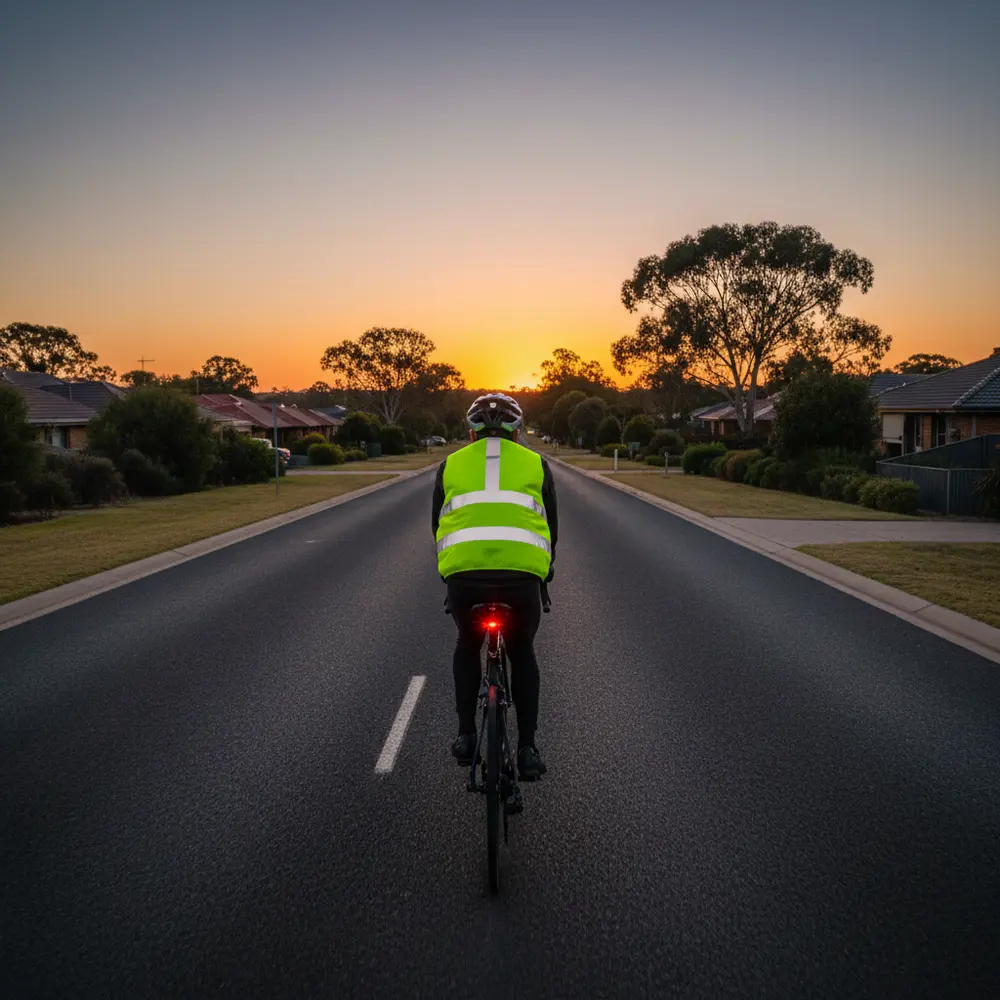
- Hi-vis vests with retroreflective strips. These are the most versatile option. A lightweight vest over your regular kit gives you both fluorescent daytime visibility and reflective night performance. Look for 360-degree reflective coverage.
- Ankle bands and leg wraps. High-impact and low-cost. The movement of your ankles in the pedal stroke creates a distinctive visual signal for approaching drivers. These are an easy add to any kit bag.
- Reflective helmet covers. Your head is one of the highest points on your body and highly visible to drivers. A retroreflective cover adds meaningful visibility without changing your helmet setup.
- Reflective cycling jackets. Commuter-specific cycling jackets often include integrated retroreflective panels. These are worth considering if you ride in the dark regularly, as they combine weather protection with visibility.
- Spoke and wheel reflectors. The rotating motion of wheel reflectors creates a strong visual cue for side-on visibility, particularly at intersections where a static seatpost reflector does little to help drivers approaching from the left or right.
For riders who want to understand what qualifies as genuinely compliant hi-vis material, the Bicycle Network cycling rules resource is a solid starting point alongside checking the AS/NZS 4602.1 standard reference.
Building a Practical Visibility Setup for Different Riding Conditions
The checklist below is structured around three common riding scenarios. Use it to self-audit your current setup. "Required" means legally mandated in most Australian states. "Recommended" means not legally required but strongly advised based on practical visibility.
| Riding Scenario | Required by Law | Strongly Recommended |
|---|---|---|
| Daytime urban riding | No light or reflector requirement in most states during daylight, good conditions | Rear flashing light, hi-vis vest or bright jacket, helmet cover |
| Dawn or dusk (low-light) riding | Front white light and red rear light if hazardous conditions apply. Check your state rules. | Front and rear lights, ankle bands, retroreflective vest, bright kit |
| Night riding | White or yellow front light, red rear light, red rear reflector | All of the above plus spoke reflectors, helmet cover, retroreflective ankle bands, high-output front light |
If you are a regular commuter, the low-light row is probably your most important one to focus on. The transition between day and dusk happens quickly, and it is easy to be caught under-equipped. Arrive Alive Victoria puts it plainly: being seen matters more than just meeting the legal minimum.
If you want more guidance on building out your broader cycling accessories kit, have a look at our accessories and modifications section for practical buying guides and setup advice.
Common Mistakes Cyclists Make With Visibility Gear
- Assuming a bright jersey is enough at night. Fluorescent colours offer almost no retroreflective value after dark. You need reflective material, not just a bright one.
- Relying on a single rear reflector and nothing else. The legally required rear reflector is a minimum, not a complete visibility solution. Add lights and motion-based reflectors on top of it.
- Mounting lights where they cannot be seen. A rear light buried under a saddle bag or pointed at the ground is not doing its job. Check the angle and position of all your lights before every ride.
- Neglecting side visibility. Lights and reflectors on the front and back do not help drivers approaching from the side. Wheel reflectors and ankle bands close this gap.
- Not checking battery charge before a ride. A dead rear light is the same as no rear light. Get into the habit of checking charge before every ride, especially if you might be caught out after dark.
- Buying cheap lights with no visible-from-distance testing. Not all lights are equal. Prioritise beam quality and run time over price alone, particularly for the front light.
If You Are New to Thinking About Visibility
- Start with the legal minimum: a white or yellow front light, a red rear light, and a red rear reflector. These are non-negotiable for night riding.
- Add ankle bands as your first upgrade. They are cheap, effective, and cover the motion-visibility gap that a seatpost reflector cannot.
- Pick up a lightweight hi-vis vest to wear over your regular kit. It works for daytime visibility and can be stashed in a jersey pocket when not needed.
- Check our contact page if you have questions about what gear suits your riding situation. We are happy to point you in the right direction.
If You Have Already Got the Basics Covered
- Audit your current setup against the three-scenario checklist above. Most experienced riders have gaps in their low-light or side-visibility setup.
- Consider a retroreflective cycling jacket if you commute in winter. It combines weather protection with serious reflective coverage.
- Add spoke or wheel reflectors for intersection safety. This is the most under-used visibility upgrade for experienced riders.
- Think about redundancy. A backup rear light in your kit costs almost nothing and has saved many a post-sunset ride from becoming a legal or safety problem.
- Have a look at our broader cycling accessories guides for gear comparisons and practical setup recommendations suited to Australian conditions.
Frequently asked questions
Is hi-vis clothing legally required for cyclists in Australia?
No. As of the time of writing, no Australian state or territory legally requires cyclists to wear hi-vis clothing. It is strongly recommended, particularly for low-light and rural riding, but the legal obligation is limited to lights and reflectors. Check your state road authority for any recent updates to local rules.
Do I need a reflector on my bicycle if I already have a rear light?
In most Australian states, yes. A red rear reflector is a separate legal requirement from your rear light, not a substitute for it. Both are required for night riding in NSW, Victoria, and Queensland. The reflector must be fitted to the bicycle, not just carried in your bag.
Can I use a flashing rear light, or does it have to be steady?
In Victoria, both steady and flashing modes are explicitly permitted under the road rules. Most other Australian states do not specifically prohibit flashing lights either, though you should check your state's road rules to confirm. A flashing rear light is widely considered more attention-grabbing than a steady light in many conditions.
What is the difference between retroreflective material and standard reflective material?
Retroreflective material is engineered to bounce incoming light directly back to its source, which is why it appears so bright when caught in headlights. Standard reflective or shiny material scatters light in multiple directions and is much less effective at returning light to a driver's eyes. Look for the term "retroreflective" when buying cycling safety gear, not just "reflective."
Are ankle reflectors or bands a legal requirement in Australia?
No. Ankle bands and similar motion-based reflectors are not legally mandated in Australian road rules. However, they are one of the most practically effective visibility tools available and are strongly recommended for any riding in low-light or night conditions. The movement of your ankle in the pedal stroke makes them disproportionately visible to approaching drivers.
Wrapping Up
Here is a quick summary of what matters most:
- Know your state's legal requirements for lights and reflectors. The basics are consistent across major Australian states but the details can differ.
- Understand that hi-vis and retroreflective are different things. You need both to be visible across all conditions, not just one or the other.
- Use motion-based visibility aids like ankle bands and wheel reflectors. They punch well above their weight in terms of driver attention.
- Go beyond the legal minimum. The law sets a floor, not a ceiling. A modest investment in additional reflective gear makes a meaningful difference.
- Run a quick pre-ride check on lights and reflectors, especially if there is any chance your ride will extend into low-light conditions.
This is educational content, not financial advice.