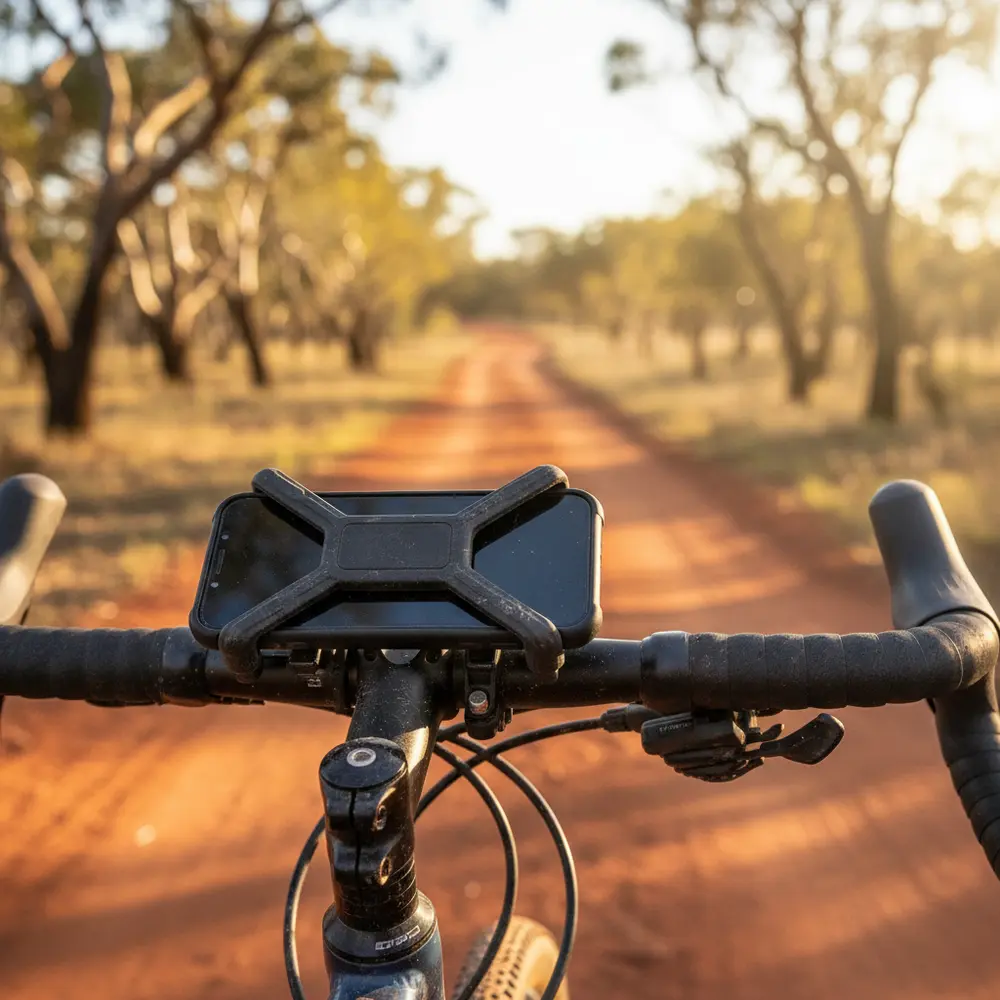
A phone mount that rattles loose on a corrugated fire trail or lets your phone cook in 38-degree direct sun is not just annoying, it is a genuine problem when you are relying on navigation in the middle of nowhere. Australian riding conditions are genuinely tougher on gear than most global buying guides acknowledge, and a mount that works fine in a European cycling video might fail you on the first rough descent at your local trail.
By the end of this article you will know what separates a solid mount from a flimsy one, which mount type suits your riding style, and how to fit and check your setup before you leave the car park. No fluff, just the practical stuff.
Note for Australian riders:
- Chip seal roads, corrugated gravel and fire trails are common across Australia and are genuinely harder on mounts than smooth tarmac.
- Australian summer heat (35 to 40 degrees Celsius in direct sun) can soften rubber components and reduce grip on lower-quality mounts over time.
- Phone use laws differ by state. In NSW, you can use your phone hands-free when it is secured in a mount, but holding it while riding is illegal and carries a fine. Check the rules in your state before heading out.
At a glance:
- Mount type matters more than brand. Rubber strap, claw-style and case-locking systems each suit different riding conditions.
- Vibration dampening is not a marketing gimmick. It genuinely reduces stress on your phone and your camera module.
- Handlebar diameter (31.8mm vs 35mm) affects compatibility. Check your bar size before buying.
- Heat and UV are Australian-specific concerns that can shorten the life of rubber and silicone mount components.
Key takeaways:
- For rough terrain, prioritise a locking or claw-style mount with rubber dampening over a basic strap design.
- Out-front mounts offer better visibility and often less vibration than direct handlebar clamp positions.
- A good mount is an investment in your phone, not just a convenience accessory.
Why Most Phone Mounts Fail on Australian Roads and Trails
Most phone mounts are designed and tested in controlled conditions. They get reviewed on smooth paths or mild gravel and perform fine. The problem is that Australian terrain throws a different set of challenges at your gear, and a lot of mounts are not built to handle it consistently.
Chip Seal, Corrugations and Gravel - The Unique Challenges of Riding in Australia
Chip seal is the standard road surface across much of regional Australia, and it sends a constant stream of high-frequency vibration through your frame and into your handlebars. Corrugated fire trails and gravel roads amplify this further. Over a long ride, that vibration works at every joint, rubber band and locking point in your mount.
The failure modes are predictable. Rubber straps stretch and lose tension. Plastic clamps crack at stress points. Twist-lock mechanisms loosen incrementally. By the time you notice the problem, your phone is either crooked or on the ground. Australian community forums like Bicycles Network Australia are full of riders sharing exactly these experiences, particularly from gravel and trail riding.
Heat adds another layer. A mount sitting on a black handlebar in 38-degree sun gets much hotter than the air temperature suggests. Rubber softens, adhesive degrades, and a mount that felt snug in the morning can have noticeable play by lunchtime. This is an often-overlooked consideration that rarely appears in overseas buying guides.
What to Look For in a Phone Mount That Actually Holds On
There are a few features that genuinely separate a reliable mount from one that will let you down. These are not marketing points. They are practical differences you will feel on the first rough ride.
Clamping Mechanism - Rubber, Screw-Tight or Tool-Free?
Rubber strap mounts are the most common and the most affordable. They are quick to fit and work fine on smooth paths and light gravel. The limitation is that rubber loses elasticity in heat and straps can creep loose on sustained vibration. They are fine for commuting and casual rides, less ideal for long gravel days.
Screw-tight clamps give you a firmer connection to the bar. A quarter-turn tightening ring is more resistant to vibration-induced loosening than a rubber loop. Tool-free screw designs are a good middle ground for most riders. Check that the clamp can handle both 31.8mm and 35mm bars, or that the right adapter is included, as this catches a lot of buyers out. A useful overview of bike phone mounts available in Australia from 99 Bikes covers this compatibility point clearly.
Mount Position - Handlebar, Stem or Out-Front?
Where the mount sits on your bike affects both visibility and vibration. A handlebar clamp mount is the simplest option and works across most bikes. A stem mount drops the phone slightly lower and more central, which some riders prefer for a cleaner cockpit. An out-front mount extends the phone ahead of the stem on a short arm, putting the screen further from the bars and slightly away from the worst vibration.
Independent vibration testing by Bike Rumor found that out-front positions can reduce the vibration transmitted to a phone compared to a direct handlebar clamp on rough surfaces. The difference is not dramatic on sealed roads but becomes more noticeable on chip seal and gravel. Out-front mounts are also easier to read at a glance, which matters when you are trying to check a map without slowing down.
Case Compatibility and Vibration Dampening
If you ride with a thick protective case on your phone, check that the mount can actually grip it securely. Some claw-style mounts struggle with bulkier cases. Case-locking systems require a specific compatible case, but the trade-off is a much more secure hold, particularly on rough terrain.
Vibration dampening is worth taking seriously if you ride a lot of gravel or rough trail. Apple has an official advisory on their Australian support pages confirming that sustained high-amplitude vibration can damage the OIS (optical image stabilisation) and autofocus systems in iPhone cameras. You can read Apple's warning on phone camera vibration damage directly. Dampening inserts, which are usually small rubber pads or a silicone interface layer, reduce the vibration reaching the phone and the camera module. They are not expensive and they are worth including in your setup if you are on rough terrain regularly.
The Main Types of Bike Phone Mounts Explained
Understanding the categories makes comparison a lot easier. Here is a plain-language breakdown of the main options you will find when shopping in Australia.
| Mount Type | How It Holds | Best For | Watch Out For |
|---|---|---|---|
| Rubber Strap | Stretchy bands over phone corners | Commuting, bike paths, casual rides | Heat softening, strap stretch on long rides |
| Claw / Clamp | Spring-loaded arms grip the phone body | Road and light gravel, most phone sizes | Bulky cases may not fit well |
| Case-Locking | Specific case clicks into a dedicated mount | Gravel, MTB, any rough terrain | Requires brand-specific case, higher upfront cost |
| RAM-Style Ball Mount | Ball and socket with adjustable arm | Versatile multi-angle setups, adventure riding | Bulkier than other options, adds weight |
| Out-Front Arm Mount | Attaches to stem or bar, extends phone forward | Road, navigation-focused riders | Can add rotational stress to the mount arm |
Top Phone Mounts Worth Considering for Australian Cyclists
Rather than a ranked list, here is what each major category looks like in the real Australian market. These are the types and brands that consistently come up in local riding communities and are genuinely available through Australian retailers like Pushys and 99 Bikes.
- Case-locking systems (e.g. Quad Lock): Quad Lock is Melbourne-founded and widely used by Australian cyclists. The two-stage twist lock is genuinely secure and the vibration dampener add-on is worth the extra cost if you ride rough stuff. Requires their own case, which is a commitment but not a dealbreaker for most.
- Claw-style mounts (e.g. Topeak RideCase, SP Connect): A good middle ground. Secure on most surfaces, compatible with a wider range of phones without needing a specific case. Worth checking max phone width before buying.
- RAM Mount systems: Popular with adventure cyclists and tourers. The ball and socket design is extremely adjustable and durable. Better suited to riders who want flexibility across multiple bikes or handlebar setups.
- Budget rubber strap mounts: Fine for the commute or the rail trail. Not the right tool for a full-day gravel ride with corrugated sections. Treat them as a short-ride solution.
For a broader look at what is available locally, Bicycling Australia's phone mount coverage is a solid Australian-focused reference point.
Pick Your Mount - A Simple Decision Tree
Use this to narrow down the right mount type for your situation. Think of it as a quick chat at the bike shop counter.
- What surface do you mainly ride? Smooth sealed roads or bike paths - any mount type works. Chip seal, gravel or fire trails - skip the rubber strap, go claw or case-locking.
- Do you use a thick protective case on your phone? Yes - check claw-style width limits carefully, or consider a case-locking system with a slim compatible case. No - most mount types will work, case-locking systems are still a good option for security.
- What is your handlebar diameter? 31.8mm (common on road bikes) or 35mm (common on MTB and some gravel bikes). Check whether the mount includes the adapter for your size or whether you need to buy it separately.
- How much do you want to spend? Under $30 - budget strap or basic clamp, fine for low-vibration riding. $30 to $80 - quality claw-style or entry case-locking. Over $80 - full case-locking system with dampener, or RAM-style for versatility.
- End result: Road commuter on sealed paths - budget clamp or rubber strap. Road sportive or long gravel day - claw-style or case-locking with dampener. MTB trail rider - case-locking system with dampening, mounted out-front or on stem. Tourer or adventure rider - RAM-style for adjustability across setups.
How to Fit and Test Your Mount Before You Head Out
Fitting a phone mount correctly takes about five minutes and saves a lot of grief on the road. These are the steps worth following every time you fit a new mount or move it to a different bike.
- Check handlebar diameter first and fit the correct adapter before mounting anything.
- Position the mount so the screen faces you at a natural downward glance angle. You should not have to tilt your head significantly to read it.
- Tighten the bar clamp firmly but not to the point of stressing the bar. For carbon bars, do not exceed the torque rating printed on the bar or stem.
- Insert the phone and engage any locking mechanism fully. Give the phone a firm tug in all directions before trusting it.
- Test it on a short ride before relying on it for navigation. Go over a speed bump or a rough patch at low speed and check that nothing has moved.
- Re-check tightness after the first few rides. New mounts sometimes settle slightly.
Quick Tips for Keeping Your Phone and Mount in Good Shape
A good mount is a small investment. Looking after it means it lasts seasons rather than months.
- Inspect rubber components at the start of summer. Heat and UV degrade rubber faster than most people expect. If a strap or pad looks cracked or stiff, replace it before it fails mid-ride.
- Clean grit and mud off the clamping surfaces after trail rides. Grit acts as an abrasive and can damage the mount body and bar finish over time.
- Store your bike out of direct sun where possible. A mount baking in a hot car boot or under a carport roof in summer will age faster than one kept in shade.
- If your phone feels warmer than usual after a ride, check whether the mount is positioning it in direct sun without any airflow. Some cases and mounts trap heat, which can affect both the phone battery and the mount materials.
- Re-check the locking mechanism before every significant ride. A two-second check takes less time than retrieving a phone from a gravel shoulder.
Common Mistakes
- Buying a mount without checking handlebar diameter. 31.8mm and 35mm are both common and not interchangeable without an adapter.
- Using a rubber strap mount on a full-day gravel or MTB ride and expecting it to hold securely through the rough stuff.
- Ignoring vibration dampening on rough terrain. If you ride chip seal or fire trails regularly, it matters for your camera module.
- Over-tightening the bar clamp on carbon bars without checking the torque limit. You can damage the bar or the mount.
- Not testing the mount on a short local ride before relying on it for navigation on a remote route.
- Assuming a mount that works in cooler conditions will perform the same in Australian summer heat. It might, but check the rubber components before committing to a long ride.
If You Are New to Bike Phone Mounts
- Start with a mid-range claw-style mount before investing in a full case-locking system. It gives you a feel for what works on your bike.
- Check that the mount fits your phone width. Minimum and maximum phone dimensions are listed on most product pages.
- A cheap mount from a department store is fine for the occasional flat path ride. If you are riding trails or long distances, it is worth spending a bit more.
- Read a few reviews from Australian riders specifically. Conditions here are different from what most global reviews test in.
- The cycling accessories section on Segment Club is a good starting point for gear advice relevant to Australian riders.
If You Have Already Used a Phone Mount Before
- If your current mount has shifted or loosened mid-ride, it is time to look at a claw-style or case-locking upgrade rather than tightening and hoping.
- Consider adding a vibration dampening insert if you ride chip seal or gravel regularly and have not done so already.
- Think about mount position. If you have only used a basic handlebar clamp, an out-front arm mount can improve readability and reduce vibration at the phone.
- If you are doing longer adventure or gravel rides, check out gravel bike accessories that pair well with a quality phone mount setup.
- Review the legal requirements for your state if you are using your phone for navigation while riding. Rules vary and are worth knowing.
A Note on the Legal Side
In most Australian states, you can use a phone for navigation when it is secured in a mount on your bike, hands-free. Holding your phone while riding is illegal and carries a fine in NSW and most other states. The NSW bicycle laws and mobile phone use page from the NSW Government sets this out clearly. If you ride across state borders or in different jurisdictions, check the local rules. A properly fitted mount keeps you legal and keeps your eyes on the road, both good outcomes.
Frequently asked questions
Can vibration from riding actually damage my phone camera?
It is a genuine risk, particularly on sustained rough surfaces like chip seal or corrugated fire trails. Apple has published an official advisory confirming that high-amplitude vibration can damage the OIS and autofocus systems in iPhone cameras. The risk is higher with rigid mounts on rough terrain than with dampened mounts on smooth roads. If you ride rough stuff regularly, a vibration-dampening mount is a sensible precaution.
Do I need a 31.8mm or 35mm mount for my bike?
It depends on your handlebar. Road bikes typically run 31.8mm bars. Many MTB and gravel bikes run 35mm bars, though some gravel bikes still use 31.8mm. Check the spec sheet for your bike or measure the bar at the clamp area. Most quality mounts include adapters for both sizes, but not all do, so confirm before buying.
Is a case-locking system like Quad Lock worth the extra cost?
If you ride rough terrain regularly, yes. The security difference between a rubber strap and a twist-lock case system on a corrugated fire trail descent is significant. The main cost is committing to a brand-specific case. If you change phones often or share mounts across different bikes and riders, factor that into the decision. For road commuting on smooth paths, a quality claw-style mount is often enough.
Can I legally use my phone for navigation while cycling in Australia?
In NSW and most Australian states, yes, provided the phone is secured in a mount and you are not holding it. Rules vary by state, so check your local road authority for specifics. Using a mount not only keeps you legal, it keeps your attention on the road rather than your hand.
Will heat affect my phone mount during Australian summer rides?
It can, particularly with rubber-heavy mounts. Prolonged exposure to direct sun and high ambient temperatures can soften rubber straps and silicone components, reducing their grip. Inspect rubber parts at the start of summer and after any ride where the mount was in direct sun for an extended period. Higher-quality mounts with UV-resistant materials tend to hold up better across Australian summers.
Wrapping Up
- Choose your mount type based on terrain first, budget second. A rubber strap is fine for smooth paths, but rough terrain needs a claw or case-locking system.
- Vibration dampening matters on chip seal and gravel. It protects your phone camera and reduces play in the mount over time.
- Check handlebar diameter and adapter compatibility before purchasing. It is the most common buying mistake in this category.
- Heat and UV are Australian-specific factors that affect rubber and silicone components. Inspect your mount at the start of each season.
- A correctly fitted, tested mount keeps you legal, keeps your phone safe, and makes navigation on long rides genuinely useful. If you have questions or want personalised advice, get in touch with the Segment Club team.
This is educational content, not financial advice.