Thousands of Australian riders are already converting their bikes to electric, often without fully understanding where the law stands on it. The gap between what you can buy online and what is actually legal to ride on public roads is wider than most people realise.
By the end of this article you will understand the national framework, the key technical rules, how the states differ, and what to check before you spend a cent on a conversion kit. This is a guide to help you make an informed decision, not a substitute for legal advice.
Note for Australia:
- E-bike rules in Australia are set at a national level by the Australian Road Rules, but each state and territory enforces and interprets them slightly differently.
- The two numbers that matter most are 250W continuous power output and 25 km/h assist cut-off speed. Both must be met for your converted bike to be treated as a bicycle, not a motor vehicle.
- Always check your state or territory transport authority website before purchasing or fitting a conversion kit, as rules can and do change.
At a glance:
- A compliant e-bike must not exceed 250W continuous rated power and must cut out motor assist at 25 km/h.
- Conversion kits that include a throttle (no pedalling required) are treated differently across states and may require registration.
- The AS/NZS 15194 compliance standard is the key certification reference for Australian e-bikes.
- Many kits sold online do not carry compliance certification, which puts the legal burden squarely on the buyer.
- A non-compliant converted bike can be treated as an unregistered motor vehicle on public roads.
Key takeaways:
- Peak wattage figures on kit packaging are not the same as continuous rated power. The law cares about continuous output.
- Throttle-controlled e-bikes face stricter rules than pedelecs in most Australian states.
- Fitting a kit that pushes your bike outside the legal definition of a bicycle can affect your insurance and expose you to serious fines.
What Is an E-Bike Conversion Kit?
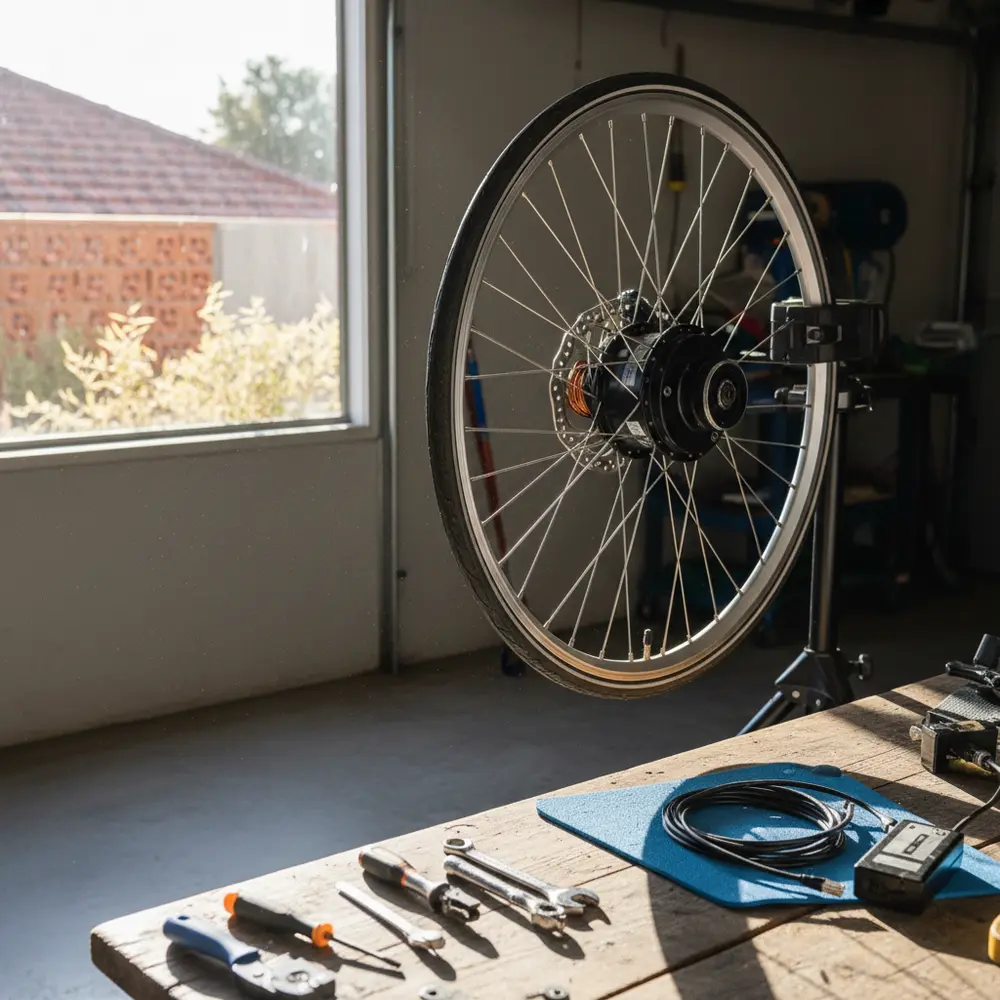
A conversion kit is an aftermarket system that adds electric motor assistance to a standard pedal bicycle. The kit typically includes a motor, a battery, a controller, and a display unit. Some kits also include sensors, wiring looms, and a throttle.
Conversion kits come in a huge range of quality and power levels. The affordable ones you find on popular online marketplaces often have very little documentation and zero Australian compliance marking. That is a problem we will come back to.
Hub Motor Kits vs Mid-Drive Kits - What Is the Difference?
The two main types of conversion kit are hub motor and mid-drive. A hub motor sits in the wheel hub, usually the rear, and drives the wheel directly. A mid-drive motor replaces the bottom bracket and drives the chain, working through the bike's existing gears.
From a legal standpoint, the type of motor matters less than the power output and the way assistance is delivered. However, mid-drive kits tend to report power output more accurately because they work through the drivetrain. Hub motor kits, especially cheaper ones, often quote peak wattage rather than continuous rated power, which can create a misleading picture of compliance.
| Feature | Hub Motor Kit | Mid-Drive Kit |
|---|---|---|
| Motor location | Wheel hub (usually rear) | Bottom bracket area |
| Power delivery | Direct to wheel | Through the chain and gears |
| Compliance risk | Peak vs continuous wattage often misrepresented | Generally more accurate power reporting |
| Installation | Simpler, wheel swap | More involved, requires BB removal |
| Cost | Usually lower | Usually higher |
How Australian Law Defines an E-Bike
Under the Australian Road Rules e-bike definition set by the National Transport Commission, a power-assisted pedal cycle must meet specific criteria to be treated as a bicycle rather than a motor vehicle. Meet those criteria and you can ride it without registration or a licence. Fail them and the vehicle is legally a motor vehicle, with all that entails.
The national framework is the baseline. States and territories adopt the model rules but can and do vary in how they apply them. That is where it gets complicated for riders who cross state borders or buy kits without checking local rules.
The 250W Continuous Power Rule and the 25 km/h Speed Limit
The two headline numbers are simple enough. The motor must not exceed 250W continuous rated power output, and the motor assistance must cut out when the bike reaches 25 km/h. You can still pedal faster than 25 km/h under your own steam. The motor just cannot be pushing you beyond that threshold.
The word "continuous" is critical here. Many conversion kits advertise 500W, 750W, or even 1000W on the packaging. Those figures usually refer to peak power, not continuous rated power. A motor that peaks at 500W might have a continuous rated output of 250W or less. But without proper documentation and certification, you have no reliable way to confirm that, and neither does a transport authority inspector.
Pedelecs vs Throttle-Controlled E-Bikes - A Critical Legal Distinction
A pedelec (pedal electric cycle) only provides motor assistance when you are actively pedalling. Stop pedalling, and the motor stops helping. This is the style that most readily fits within the legal definition of a bicycle across all Australian states.
A throttle-controlled e-bike can propel the rider without any pedalling at all, similar to a scooter or motorcycle. That distinction matters a great deal to transport authorities. VicRoads electric bike rules are clear that throttle-assisted e-bikes that operate without pedalling are not treated as bicycles and require registration. Most other states take a similar position, though the specifics vary.
The AS/NZS 15194 Standard - Why It Matters for Conversion Kits
The AS/NZS 15194 compliance standard is the Australian and New Zealand technical standard for electrically power-assisted cycles. It sets out the exact requirements a compliant e-bike must meet, including the 250W continuous power limit, the 25 km/h cut-off, and a range of safety and electrical requirements.
Here is the catch with conversion kits. Most factory-built e-bikes are tested and certified against this standard before they are sold. Conversion kits, especially those bought online from overseas marketplaces, almost never carry AS/NZS 15194 certification. A kit might claim to be "250W" on the box, but without independent certification, that claim is unverified. Fitting an uncertified kit does not automatically make your bike non-compliant, but it does mean you are relying entirely on the manufacturer's word, and that is a thin defence if something goes wrong.
Some states reference the European EN 15194 standard as an acceptable equivalent. However, you should check with your state transport authority directly rather than assuming equivalence, as the position can differ between jurisdictions.
State and Territory Variations You Need to Know
The national rules provide the floor, but each state and territory can interpret and enforce them differently. The table below summarises the key points for the most populous states. Always verify with the relevant transport authority before riding.
| State / Territory | Power Limit | Speed Cut-off | Throttle Bikes | Authority |
|---|---|---|---|---|
| New South Wales | 250W continuous | 25 km/h | May require registration | Transport for NSW |
| Victoria | 250W continuous | 25 km/h | Treated as motor vehicle, registration required | VicRoads |
| Queensland | 250W continuous | 25 km/h | Some low-speed throttle provisions - verify current rules | TMR Queensland |
| Western Australia | 250W continuous | 25 km/h | Treated as motor vehicle without registration | WA Dept of Transport |
Where Throttle E-Bikes Are Treated Differently
Queensland has historically had provisions that allowed certain low-speed throttle e-bikes under specific conditions. That position has shifted over time and the current rules should be verified directly with the Queensland e-bike rules on the TMR website before you ride. Do not rely on older forum posts or secondhand advice on this one.
In Western Australia, throttle-only bikes that do not require pedalling are clearly treated as motor vehicles. Riders of compliant pedelecs in WA do not need registration, a licence, or compulsory third-party insurance. Step outside that definition and all three requirements apply.
The broader picture is that Australian e-bike rules remain inconsistent across jurisdictions, which is something advocacy groups like Bicycle Network have been pushing to fix for years. Until that harmonisation happens, the safest approach is to check the rules for every state you intend to ride in.
Can a Conversion Kit Ever Be Fully Compliant?
In theory, yes. In practice, it is difficult to achieve with most kits currently available on the market. For a converted bike to be genuinely compliant, the kit would need to produce no more than 250W continuous rated power, cut motor assistance at 25 km/h, and ideally carry AS/NZS 15194 certification or equivalent documentation.
The challenge is that very few aftermarket conversion kits come with independent certification. Some higher-quality kits from reputable suppliers include documentation that supports a compliance argument, but you need to scrutinise that documentation carefully. A compliance claim from the manufacturer is not the same as independent third-party certification against the standard.
If you are serious about compliance, look for kits that provide a continuous rated power specification (not just peak), include a speed cut-off that is factory-set at 25 km/h and cannot easily be overridden, and come with technical documentation that matches the AS/NZS 15194 requirements. That narrows the field considerably.
Conversion Kit Compliance Decision Guide
Work through these questions before you fit a kit. Each answer points you toward a likely outcome. This is a guide only. Check with your state transport authority for a definitive answer.
- Does the kit exceed 250W continuous rated power? If yes, the resulting bike is likely non-compliant and may be classified as a motor vehicle. If no (and you have documentation to prove it), move to question 2.
- Does the kit include a throttle that operates without pedalling? If yes, the bike may be classified as a motor vehicle in most states regardless of power output. If no (pedelec only), move to question 3.
- Does the assist cut out at 25 km/h? If no, the bike is likely non-compliant. If yes, move to question 4.
- Does the kit carry AS/NZS 15194 certification or documented equivalent? If yes, you are in the best position to argue compliance. If no, you are in a grey area. The kit may still function within legal parameters, but you have no independent certification to rely on.
- Have you checked your specific state transport authority? If no, do that before riding. Rules vary and enforcement approaches differ across jurisdictions.
What Happens If Your Converted Bike Is Not Compliant?
A non-compliant converted bike can be treated as an unregistered motor vehicle under Australian road rules. That means riding it on public roads without registration, a licence, or compulsory third-party insurance could expose you to significant fines, and potentially more serious consequences if you are involved in a crash.
From an insurance perspective, fitting a non-compliant kit can void your home and contents cover for the bike, and it may affect your liability in a personal injury claim if the bike is found to be an unregistered motor vehicle at the time of an incident. The RACQ e-bike guide flags insurance implications as one of the key risks for riders using non-compliant converted bikes. This is not an area where it pays to be casual.
There is also the practical reality of enforcement. Transport authorities and police generally do not have roadside equipment to measure continuous wattage on the spot. However, that does not make a non-compliant bike legal, and it is not a sensible basis for your decision-making. If your bike is involved in an incident, a detailed technical inspection can and does happen, and the results can have real financial and legal consequences.
Common Mistakes to Avoid
- Assuming peak wattage equals continuous rated power. They are not the same figure and the law uses continuous rated power.
- Buying a kit because it says "250W" on the box without checking whether that refers to peak or continuous output.
- Fitting a throttle without checking whether throttle-assisted operation is treated as legal bicycle use in your state.
- Relying on forum posts or secondhand advice for state-specific rules. Rules change and forum advice goes stale.
- Not checking whether your existing frame and brakes are rated to handle the additional forces a motor kit introduces.
- Assuming the conversion is covered by your existing bike or home insurance without checking the policy.
If You Are New to E-Bike Conversions
- Start by reading the NTC framework so you understand the national baseline before diving into state-specific rules.
- Look for kits that clearly state both peak and continuous power ratings in their technical documentation.
- Prefer pedelec-style kits (pedal-activated assist only) over throttle kits. They are much less legally complicated across all states.
- Check your state transport authority website directly. NSW, Victoria, Queensland, and WA all have dedicated e-bike pages.
- Consider asking a bike shop that specialises in e-bikes to assess the kit before you buy. A good mechanic can spot compliance red flags quickly.
- If you are also interested in other cycling accessories and bike modifications, make sure any changes you make to the bike do not compound compliance issues.
If You Have Fitted a Conversion Kit Before
- Review the documentation that came with your existing kit against the 250W continuous and 25 km/h cut-off requirements. Not just what you were told at the time.
- Check whether the speed limiter on your existing kit is factory-set or user-adjustable. An adjustable limiter is a compliance risk.
- If your kit includes a throttle, verify the current rules in every state you ride in. The rules around throttle bikes have tightened in some jurisdictions over recent years.
- Consider whether your kit carries any AS/NZS 15194 documentation. If it does not, understand what that means for your legal position.
- If you are upgrading to a more powerful kit, do not assume the new kit is compliant just because the old one seemed fine.
- Have questions about your specific setup? Feel free to get in touch with us and we can point you in the right direction.
Frequently asked questions
Is it legal to fit a conversion kit to my bike in Australia?
It can be, but it depends entirely on the kit. The converted bike must not exceed 250W continuous rated power, must cut out motor assist at 25 km/h, and should not include a throttle that allows operation without pedalling if you want to ride it as a bicycle without registration. Many kits sold online do not meet these requirements or lack the documentation to demonstrate they do.
What does "250W continuous rated power" actually mean?
Continuous rated power is the sustained output the motor can maintain without overheating, measured under standardised test conditions. Peak power is the maximum the motor can produce in short bursts. Australian road rules refer to continuous rated power, not peak. A motor marketed as 500W peak may or may not have a continuous rating of 250W or below. Always ask for the continuous rated figure and look for documentation to back it up.
Do I need to register my converted e-bike?
If your converted bike meets the 250W continuous power limit and the 25 km/h assist cut-off, and functions as a pedelec (pedal-activated assist only), you generally do not need to register it or hold a licence in any Australian state. If it exceeds those limits, includes a throttle that operates without pedalling, or cannot be demonstrated to comply, it may be classified as a motor vehicle and require registration. Check your specific state transport authority for a definitive answer.
Does AS/NZS 15194 certification guarantee my converted bike is road legal?
Certification against AS/NZS 15194 is the strongest compliance argument you can make for an e-bike or conversion in Australia. It does not automatically override state-specific rules, but it provides credible evidence that the bike meets the technical standard. The problem is that most aftermarket conversion kits do not carry this certification, so the compliance argument depends on the buyer's own due diligence and any available technical documentation.
Can I ride my converted e-bike on shared paths and bike lanes?
A converted e-bike that meets the legal definition of a bicycle (250W continuous, 25 km/h cut-off, pedelec-style assist) can generally be ridden wherever a standard bicycle is permitted, including shared paths and bike lanes. A non-compliant converted bike classified as a motor vehicle may be restricted from those spaces. Rules around path access for e-bikes vary slightly by state, so it is worth checking locally if you are unsure. You can also explore our routes and rides content for more on where to ride across Australia.
Wrapping Up
Here is the short version before you make any decisions.
- The 250W continuous power limit and 25 km/h assist cut-off are the two numbers that define a legal e-bike in Australia.
- Throttle-controlled operation without pedalling is treated as a motor vehicle function in most states, not a bicycle function.
- AS/NZS 15194 certification is the gold standard for compliance evidence, and most cheap online kits do not have it.
- State rules vary. Always check the transport authority website for the state you ride in before purchasing or fitting a kit.
- A non-compliant converted bike can expose you to fines, registration obligations, and insurance complications that are genuinely worth avoiding.
Want to keep up with cycling news, gear reviews, and practical riding advice for Australian cyclists? Visit Segment Club for more content written for riders who actually ride.
This is educational content, not legal advice.