If you have ever walked back to where you locked your bike and found nothing but a cut cable and a sense of dread, you already know why this guide exists. Bike theft in Australian cities is common, largely opportunistic, and almost entirely preventable with the right gear and a solid habit.
By the end of this guide you will be able to choose the right lock type for your situation, use it in a way that actually protects your bike, and build a simple security system around it. Whether you are locking up at Flinders Street Station or outside Town Hall in the Sydney CBD, this is the practical walkthrough you need.
Note for Australia:
- Bike theft is significantly under-reported across Australia, so official figures undercount the real scale of the problem, according to Bicycle Network.
- Lock requirements vary between insurance providers. Check your product disclosure statement before assuming your current lock qualifies for a theft claim.
- Kryptonite and ABUS are the most readily available quality lock brands through Australian bike shops and online retailers. Always confirm local stock before ordering.
At a glance:
- D-locks are the strongest option for urban locking in Sydney and Melbourne.
- The locking method matters as much as the lock itself. Poor technique defeats an expensive lock.
- Use two locks for bikes worth over $1,000 or for any overnight locking situation.
- Register your serial number, consider a GPS tracker, and check your insurance policy conditions.
Key takeaways:
- Match your lock rating to your bike value and how long it will be left unattended.
- Always lock through the frame, not just a wheel or accessory.
- Secure bike cages at train stations and end-of-trip facilities are worth using when available.
Why Bike Theft Is a Real Problem in Sydney and Melbourne
Cycling is growing fast in both cities, and so is the number of bikes parked on the street every day. More bikes on street furniture means more opportunity for thieves, and most of them are not sophisticated criminals. They are opportunists who walk past a poorly locked bike with a pair of bolt cutters in a backpack.
The uncomfortable truth is that no lock is completely theft-proof. What a good lock does is raise the time and effort required to steal your bike to a point where a thief moves on to an easier target. That is the game you are playing.
How Often Do Bikes Get Stolen in Australian Cities?
Bicycle theft is widely acknowledged to be heavily under-reported in Australia. Many riders do not bother filing a police report because they expect nothing to come of it. That said, bicycle theft in Australia affects tens of thousands of cyclists each year, with opportunistic theft in public spaces being the most common scenario. Victoria Police bicycle theft advice encourages riders to report every theft regardless, because the data shapes future policing priorities. Even if your bike is not recovered, your report counts.
Types of Bike Locks Explained
There are four main lock types available in Australia. Each has a different weight, security level, and portability trade-off. Understanding what you are buying before you spend money is worth five minutes of your time.
| Lock Type | Security Level | Portability | Best For | Price Range (AUD) |
|---|---|---|---|---|
| D-Lock (U-Lock) | High | Moderate. Clips to frame. | CBD locking, all-day leave | $80 - $200+ |
| Chain Lock | High (if hardened) | Low. Heavy to carry. | Cargo bikes, panniers, overnight | $80 - $250+ |
| Folding Lock | Medium to High | High. Folds compact. | Daily commuters, mixed stops | $80 - $180+ |
| Cable Lock | Low | Very High. Light and flexible. | Secondary lock only | $15 - $50 |
D-Locks (U-Locks) - The Gold Standard for Urban Riding
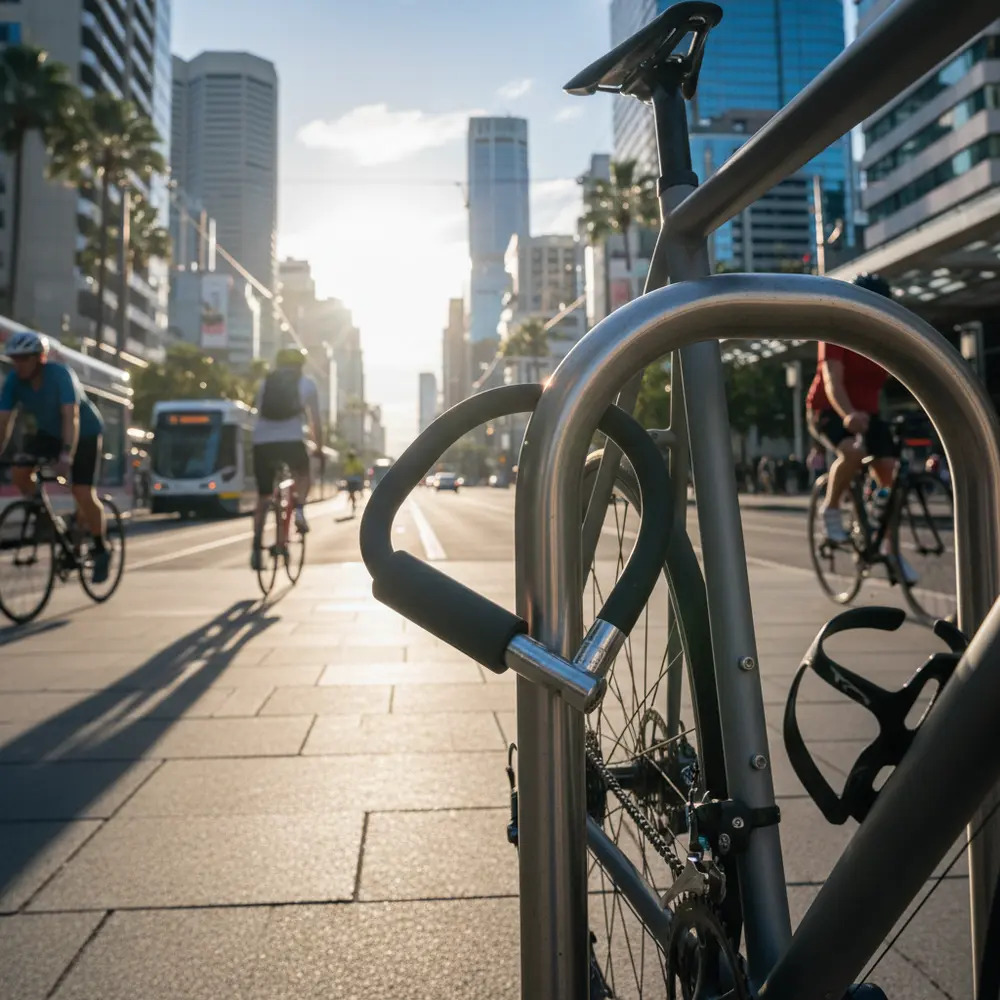
A quality D-lock from Kryptonite or ABUS is still the benchmark for urban security in Australia. The rigid shackle resists bolt cutters better than chain or cable, and the compact internal space limits the leverage an attacker can apply with a bar or jack. The trade-off is that the small opening can make locking to some infrastructure awkward, especially thicker posts. Look for hardened steel shackles and a solid locking mechanism, and you will have a lock that does its job without drama. D-locks from Kryptonite and ABUS consistently rate highest for urban security in Australian reviews.
Chain Locks - Heavy but Reliable
A chain lock with hardened manganese steel links and a solid padlock is a serious deterrent. The length gives you more flexibility to lock to wider infrastructure, and a quality chain resists bolt cutters far better than a cable. The catch is weight. A decent chain lock can be well over a kilogram, which is fine if you have panniers but annoying if you are carrying it in a backpack. They suit cargo bike riders and anyone who needs to lock to varied, larger anchor points.
Folding Locks - The Commuter Compromise
The ABUS Bordo series is the most recognised folding lock in Australian bike shops. It folds down to a compact bar that mounts neatly on the frame, and higher-rated models offer solid protection for a few hours in a busy street environment. They are not quite as rigid as a D-lock under attack, but the combination of portability and decent security makes them a popular everyday choice. If you commute daily and need to stop at multiple places, a folding lock is worth considering.
Cable Locks - Better Than Nothing, But Not By Much
A cable lock is not a primary security tool in a city environment. Standard cables can be cut quickly with basic tools, and experienced thieves know this. Use a cable lock as a secondary measure to secure a wheel or seat when your primary lock is already on the frame. Do not rely on one alone, especially in inner-city areas of Sydney or Melbourne. They have their place in the toolkit, but that place is not as your only line of defence.
How to Rate a Lock's Security Level
ABUS uses a 1 to 15 security level scale on their locks, with level 10 and above recommended for higher-risk urban environments. This is one of the most transparent rating systems available and is worth understanding when comparing options. Sold Secure (a UK-based certification) is another rating you will see on premium locks sold in Australia, with Gold being the highest tier. These ratings reflect resistance to common attack methods and are a useful shortcut when comparing products, though no rating guarantees a lock cannot be defeated given enough time and the right tools. Match the rating to your situation: a level 6 lock is fine for a $200 bike left for 20 minutes in a quiet suburban spot, but not for a $3,000 road bike in the Melbourne CBD. ABUS security level ratings explained in plain terms on their website are genuinely useful reading before you buy.
How to Lock Your Bike Properly - The Method Matters as Much as the Lock
Buying a strong lock and using it badly is a very common mistake. These are the core principles, based on how to lock a bike properly as outlined by Kryptonite.
- Always lock through the frame, not just a wheel. A wheel can be removed and the frame walked away without it.
- Include the rear wheel in the lock if possible. The rear wheel costs more to replace and is the hardest to remove quickly.
- Fill the internal space of the D-lock as much as possible. Less empty space means less room for a lever or jack attack.
- Point the keyway downward. This makes picking and shimming harder and keeps the mechanism cleaner.
- Lock to a fixed, immovable object. If the anchor point can be lifted over or unbolted, your lock is irrelevant.
- Use a secondary cable or lightweight chain to secure the front wheel and saddle if you are leaving the bike for more than an hour.
The Sheldon Brown locking method positions the D-lock through the rear triangle and rear wheel only, relying on the frame geometry to prevent removal. This is widely used and generally accepted as a solid technique, though it does leave the front wheel unsecured unless you add a secondary lock.
Best Places to Lock Up in Sydney and Melbourne
Where you lock matters almost as much as what you lock with. A high-quality lock on a flimsy piece of street furniture is a weak point waiting to be exploited. In Sydney, secure bike parking in NSW is best found at inverted U-rails and secure bike cages at major train stations rather than the old-style wheel-bender hoops that cannot secure a frame at all. In Melbourne, the City of Yarra bicycle parking page maps bike rail locations and secure cage access points across the inner city. Use these resources to plan your stops before you need them.
What to Look for in a Street-Side Bike Rail or Post
- Inverted U-rails are the best option. They let you lock both the frame and wheel through one point.
- The anchor must be bolted into concrete or a fixed structure, not just surface-mounted.
- Avoid locking to street signs, thin poles, or fences. These can be lifted over, cut, or removed.
- Busy, well-lit, high-foot-traffic locations reduce theft risk. Thieves prefer to work unseen.
- Do not lock to non-designated infrastructure in Melbourne. City of Yarra notes that bikes attached to signs or fences may be removed by council.
Should You Use One Lock or Two?
For most commuters with a mid-range bike left for a few hours in a busy area, a single quality D-lock used correctly is a reasonable minimum. Once your bike value goes above $1,000, or if you are leaving it overnight, a two-lock approach is the right call. The logic is straightforward: two different lock types require two different attack methods, and that extra time and effort is often enough to send a thief elsewhere. The combination most Australian riders settle on is a D-lock on the frame and rear wheel, with a cable or lightweight chain through the front wheel and to the saddle rails.
Recommended Bike Locks Worth Buying in Australia
These are the brands you will find in Australian bike shops and from reputable online retailers. Prices vary, so treat these as ballpark figures and confirm availability locally before ordering.
- Kryptonite Evolution Series D-lock - Widely available, strong track record, good value in the mid-range. The Evolution Mini is popular for its compact size and lighter carry weight.
- ABUS Granit X-Plus D-lock - High security rating, German engineering, stocked by most quality Australian bike shops. A step up in price but a solid investment for a higher-value bike.
- ABUS Bordo Granit folding lock - The go-to folding lock for commuters. Compact carry, reasonable security level for a few hours in the city.
- Kryptonite KryptoFlex cable lock - Use this as a secondary lock for your front wheel and saddle, not as a standalone solution.
- Hiplok Gold chain lock - Available through select Australian retailers and online. Wearable design and solid security for those who prefer chain locks.
Mid-range locks in the $80 to $150 AUD range offer the best balance of security and value for most commuters, based on reviews focused on the Australian market.
Quick Reference - Lock Type Comparison
Use this table as a fast decision reference when you are weighing up your options.
| Situation | Recommended Lock | Secondary Lock? |
|---|---|---|
| Under 30 mins, quiet suburban street, low-value bike | D-lock or folding lock | Optional |
| A few hours, CBD street rail, mid-value bike | Quality D-lock (ABUS/Kryptonite) | Yes, cable for front wheel |
| All day, city centre, high-value bike | D-lock plus chain lock | Both used together |
| Overnight, outdoor, any bike value | Not recommended outdoors. Use a secure cage or indoor storage. | N/A |
| Secure bike cage or indoor parking | D-lock or folding lock for added peace of mind | Optional |
Decision Tree - Choosing Your Lock and Strategy
Work through these questions to land on the right approach for your situation.
- How long are you leaving the bike? Under 30 minutes in a quiet spot: a single quality D-lock or folding lock is fine. A few hours in the CBD: use a quality D-lock with a secondary cable or chain. Overnight: do not lock outdoors if you can avoid it. Use a secure cage or bring the bike inside.
- What is the environment? Busy CBD street rail at Flinders Street or Town Hall: use your best lock and add a secondary. Quiet suburban post: a solid D-lock on its own is reasonable. Secure indoor cage: a lighter lock is fine as a backup layer.
- What is your bike worth? Under $500: a mid-range D-lock or folding lock is adequate. $500 to $2,000: quality D-lock plus secondary lock. Over $2,000: two high-rated locks, GPS tracker, and check your insurance conditions.
- Are you commuting daily or riding recreationally? Daily commuter: invest in a quality folding lock or D-lock that mounts cleanly to your frame, so you actually carry it every day. Recreational rider making occasional stops: a D-lock in a bag works fine for ad-hoc locking needs.
Beyond the Lock - Building a Security System
A lock is one layer of security, not the whole system. The riders who rarely lose bikes tend to combine a few simple measures that work together.
- Register your serial number. In NSW, register your bike in NSW through the official NSW Government guidance. In Victoria, Victoria Police bicycle theft advice recommends recording your serial number and storing it separately from the bike. A registered serial number is the main way police can return a recovered bike to its owner.
- GPS tracker. A small GPS unit hidden inside the handlebars or under the seat gives you a real-time location if the bike moves. It will not stop a theft, but it dramatically improves recovery chances and gives police actionable information.
- Security skewers. Replace quick-release skewers on your wheels and seat post with locking skewers that require a proprietary key. Component theft alongside or instead of whole-bike theft is common in inner-city areas.
- Insurance. Check whether your home and contents policy covers bicycle theft and what lock conditions apply. Many Australian policies require the bike to be locked to a fixed object with a quality lock for a claim to be valid. Some require a minimum security rating. Bicycle insurance in Australia is worth understanding before you need it, not after.
- Photograph your bike. Keep a photo showing any distinguishing marks, your serial number, and your accessories. This is simple to do and makes a real difference in the event of a claim or police report.
Common Mistakes
- Locking only through a wheel, leaving the frame free to be taken with the wheel removed.
- Using a cable lock as the primary lock in a city environment.
- Locking to a street sign, thin post, or fence that can be lifted over or cut.
- Buying a quality lock and then leaving excessive internal space for a leverage attack.
- Leaving a bike locked outdoors overnight without checking your insurance conditions first.
- Trusting a fixed anchor point without checking whether it is actually secured to the ground.
If You Are New to Locking Up in the City
- Start with a quality D-lock from ABUS or Kryptonite. It is the most reliable single lock for city use.
- Learn to lock through the frame and rear wheel every time, not just a wheel or seat stay.
- Look for inverted U-rails rather than old hoop-style racks. They are a better anchor point for your lock.
- Register your serial number before you need it. It takes five minutes and costs nothing.
- Check out our guide on cycling accessories for other gear worth adding to your setup.
If You Have Locked Up in the City Before
- Review your locking technique. Even experienced riders sometimes skip the rear wheel or leave too much slack in the lock.
- Consider a two-lock setup if your bike is worth over $1,000 or you leave it in high-risk spots regularly.
- Look into security skewers for your wheels and saddle if you have not already.
- Add a GPS tracker to your bike. It is the one layer most riders skip and then regret.
- Read your insurance product disclosure statement and confirm your current lock meets the required conditions for a theft claim to be valid.
Frequently asked questions
Is a cable lock good enough for locking my bike in Sydney or Melbourne?
No, not as your only lock. Cable locks are suited to supplementary use only, such as securing a front wheel when your D-lock is already on the frame. Standard cables can be cut quickly with basic tools and are well known to thieves working in inner-city areas. Use a D-lock or folding lock as your primary security and add a cable if you need to cover extra components.
Do I need to use two locks?
It depends on your bike value, how long you are leaving it, and where. A single quality D-lock used correctly is a reasonable minimum for a mid-range bike left for a few hours in a visible public location. For bikes over $1,000 or any overnight situation, two locks of different types is the right approach. Two locks require two different attack methods, which significantly increases the time and effort required.
What is the best lock brand available in Australia?
Kryptonite and ABUS are the two most consistently recommended and locally stocked brands in Australian bike shops. Both offer a range of D-locks, chain locks, and folding locks at different price and security levels. Hiplok is also available through select retailers. Confirm local stock before ordering online to avoid import delays and warranty complications.
Will my insurance cover my bike if it gets stolen?
It depends on your policy. Many Australian home and contents policies require the bike to be locked to a fixed structure with a quality lock for a theft claim to be valid. Some dedicated bicycle insurance policies specify a minimum lock security rating. Read your product disclosure statement carefully and make sure your lock and locking method meet the conditions. Registering your serial number and keeping a purchase receipt will also assist in any claims process.
Is it okay to lock my bike outdoors overnight?
In general, it is not recommended. Overnight outdoor locking gives a thief time and privacy to work, which negates much of the deterrent value of even a high-rated lock. Many insurance policies also have conditions around overnight outdoor storage that may affect a claim. If you must leave a bike outside overnight, use two high-rated locks, choose a well-lit and high-traffic location, and check your insurance conditions first. A secure bike cage or indoor storage is always the better option.
Summary
- Choose a D-lock or quality folding lock as your primary security tool in Sydney or Melbourne.
- Lock through the frame and rear wheel to a fixed, immovable anchor point every time.
- Add a secondary lock for bikes over $1,000 or any locking situation lasting more than a few hours.
- Build a simple security system: quality lock, serial number registration, GPS tracker, security skewers, and insurance that actually covers theft.
- Check your insurance product disclosure statement now, before a theft makes it urgent.
Have questions about setting up your bike security or not sure which lock suits your commute? Get in touch with the Segment Club team and we will point you in the right direction.
This is educational content, not financial advice.